Goa traditional food in one plate
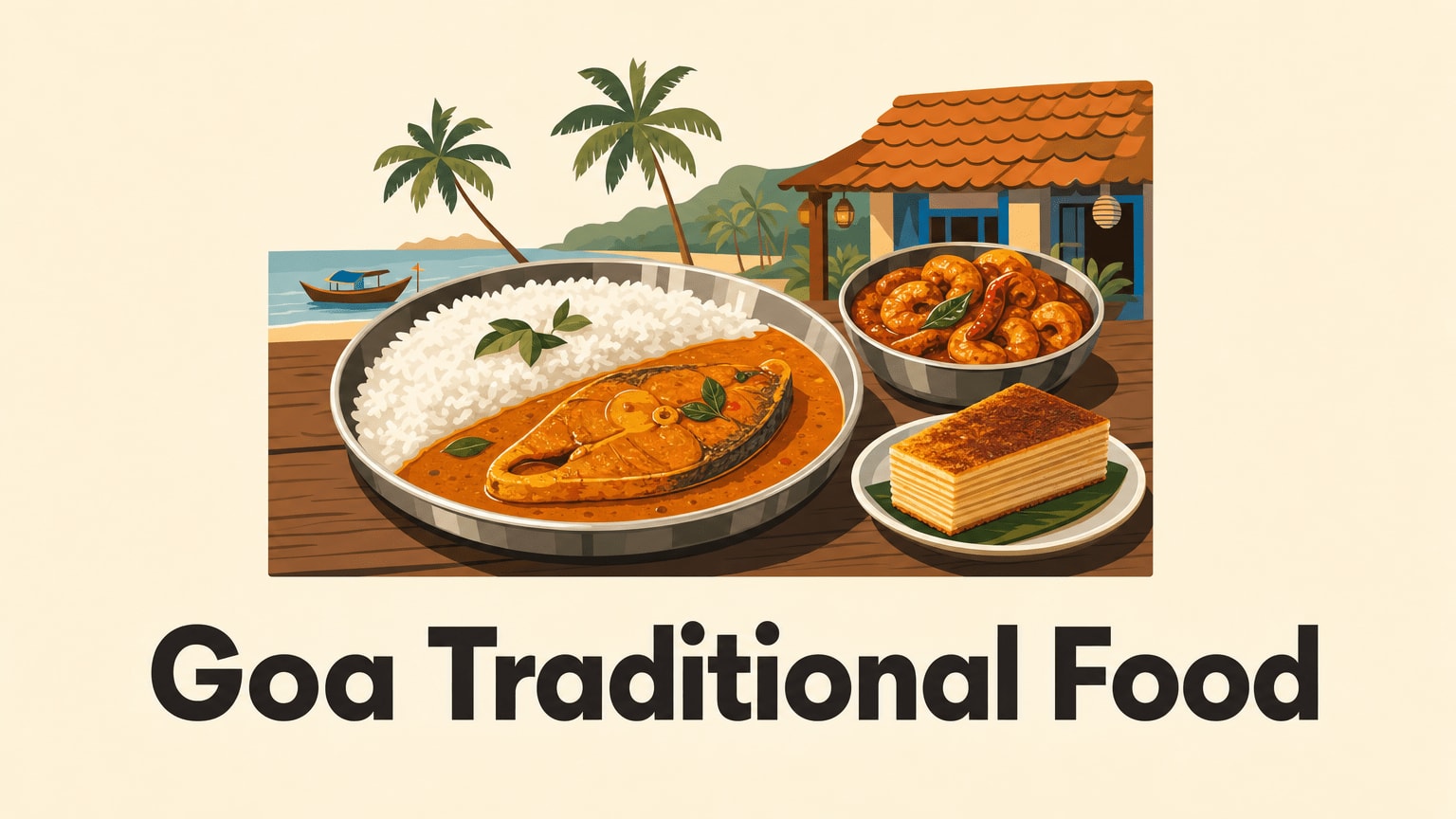
In short: Goa traditional food starts with fish curry and rice, the everyday meal. It comes from two kitchens, Hindu and Catholic, which is why menus also carry vindaloo, sorpotel and bebinca.
You search for Goan food and get ten dish names with the same photo of a fish curry. Then you sit down at a table with a long menu and can’t tell a vindaloo from a xacuti. Fair enough. Most lists skip the part that makes the menu make sense.
If you want the hotel, transfers and sightseeing sorted in one place, VeeTrips lists a Delhi-departure Goa package with the inclusions spelled out. Check whether meals are in it, because that decides how much of what follows you’ll be ordering yourself. Our Goa packages checklist covers what else to check before you pay.
The rest of this page sorts the food the way Goans do: by kitchen, then by meal, then by season. I haven’t included restaurant names or prices. I couldn’t find a dated source for either, and a made-up rupee figure for a fish thali is no help to you.
Two kitchens, not one
Goan food isn’t one cuisine with one set of rules. it has a Hindu tradition and a Catholic one, and the dishes you see on menus lean on both.
The Hindu kitchen is mainly pescetarian and lacto-vegetarian. That means fish and dairy, but no meat. It’s mild, cooks in coconut oil, gets its sourness from kokum and tamarind, and its sweetness from jaggery. The Catholic kitchen is a fusion of that Goan Hindu cooking with Portuguese styles. Vinegar made from local toddy, which is coconut sap fermented for four to six months, gives its meat dishes their tang.
The two Goan kitchens side by side
| Hindu Goan | Catholic Goan | |
|---|---|---|
| What’s eaten | Fish, vegetables, dairy | Fish, pork, chicken, and more |
| Cooking medium | Coconut oil | Coconut, with toddy vinegar for tang |
| Sour and sweet | Kokum, tamarind, jaggery | Vinegar, with Portuguese influence |
| You’ll know it by | Mild, coconut-led curries | Sharper, spicier meat dishes |
Why does this matter on a trip? Because it answers a question vegetarians in a group always ask. A vegetarian can eat well in Goa, but the famous names on a tourist menu (vindaloo, sorpotel, cafreal) come mostly from the Catholic side and are meat or fish. Ask for the vegetable curries and the coconut-based dishes, and say so before you order.

The everyday meal: fish curry and rice
Start here, because everyone in Goa does. The Goan staple diet is rice and fish curry, along with pickles and fried fish. Goan food is considered incomplete without fish, and kingfish is among the most commonly eaten.
In Konkani the curry is xit kodi. Fish curry and rice forms the staple food of the Goan Catholic community. Goan curries use coconut, coconut oil and curry leaves with chillies, spices and vinegar, and cousins exist for every mood: a sour one called ambot tik, a coconut and kokum one called solantulem kodi, a cumin one called jeerem-meerem.
Fish isn’t one thing either. Beyond kingfish, you’ll see pomfret, shark, tuna and mackerel, and shellfish such as crabs, prawns, squid and mussels. At a beach shack, you often get to point at what’s fresh.
Dishes worth ordering, and what they actually are
Here is the short glossary I’d want in my pocket.
Goan dishes, in plain words
| Dish | What it is | Eat it with |
|---|---|---|
| Fish curry | Coconut-based fish curry, the daily meal | Rice |
| Ambot tik | A spicy and sour fish curry | Rice |
| Vindaloo | A spicy pork curry | Rice or bread |
| Xacuti | Roasted grated coconut with chicken or lamb | Rice or bread |
| Sorpotel | A very spicy pork dish | Sannas or pão |
| Cafreal | Coriander and green chilli marinade, for chicken or fish | A main meal |
| Balchão | A pickled curry made with prawns | Rice, or on its own |
Vindaloo. If you only know it from a restaurant abroad, forget the potatoes. In Goa it’s usually made from pork, and a traditional version has no meat besides pork and no potatoes. Ask what it’s made of if you don’t eat pork.

Sorpotel and sannas. This is the festive one. Among Goan Catholics, sorpotel with sannas (steamed rice cakes) is the main dish at wedding dinners and Christmas dinner. Sannas are a moist, spongy rice cake, a cousin of idli, which tells you something about where Goan food sits in the country. It’s not a daily order, and it’s hot, so go in knowing that.

Xacuti and cafreal. Both show up on Indian menus far from Goa, and that’s partly the point. At a Goan table, xacuti is the one with roasted grated coconut, and cafreal is the coriander and green chilli marinade, mostly for chicken or fish.

Balchão. A pickled prawn curry. Balchão and its fish cousin, molho de peixe, are famous Goan fish preserves, and prawn balchão is also counted among the Portuguese-influenced dishes. It’s strong, sharp and keeps well, which is the idea.


Bread, pickles and the Portuguese thread
Before the Portuguese, Goans ate flatbreads such as rotis and chapattis. The Portuguese brought pão, bread, and it’s now part of the table. A sorpotel with pão is a different meal from a curry with rice, and a good one.
Toddy vinegar is the other trace. It’s why Catholic Goan meat dishes have that sharpness a plain chilli curry doesn’t. Kingfish in garlic is another Portuguese-influenced dish, and serradura is a Portuguese dessert said to be found exclusively in Goa.
I’ll flag one thing I couldn’t pin down. Plenty of food pages say the Portuguese brought chillies, potatoes and tomatoes to Goa. Those claims are tagged “citation needed” in the sources I read, so I’m not repeating them as fact.
Sweets: bebinca and the Christmas box
Bebinca is the dessert to know. It’s a layered pudding of flour, sugar, ghee, egg yolk and coconut milk, traditionally with 7 to 16 layers, and it’s called the Queen of Goan Desserts. It’s especially popular at Christmas but available year-round, and preparing it is “a slow process”. It also keeps well and travels easily, so it’s an easy one to carry home.
At Christmas, Goan Catholic families give out consoada, a set of sweets shared with family, friends and neighbours. Goan Catholic favourites include bebinca, dodol, godshem, patoleo, cocada, goiabada and cashew marzipan. If you’re invited to a Goan home at Christmas, expect sweets, and expect to be sent off with some.
What to eat when
| Time | Usually on the table |
|---|---|
| Any day | Fish curry and rice, pickles, fried fish |
| Weddings and Christmas dinner | Sorpotel with sannas |
| Christmas | Bebinca and the other consoada sweets |
| Beach days | Seafood at a shack |
If your dates are around Christmas, our month by month guide covers what the weather and the crowds usually do. The last week of the year is usually packed, so book tables as well as rooms.

Feni, the drink with a protected name
You’ll be offered feni. It comes in two kinds: cashew feni, from the cashew apple, and coconut feni, from coconut-palm sap. Cashew feni has Geographical Indication protection, so it can only be made in Goa, and the cashew arrived with the Portuguese in the mid-16th century. The cashew feni registration dates to 2009, and the cashew season runs from late February to mid-May.

Is it nice? The honest answer: it has a strong taste, some like it and some don’t, and the smell can be unpleasant. Taste a small glass before you commit to a bottle. There’s also urrak, a lightly alcoholic local drink with a smoky flavour, if feni is too much.
How to eat well on a trip
The advice you’ll read is blunt, and I agree with it: most beaches have shacks serving surprisingly delicious meals, especially seafood, and you shouldn’t miss the experience. It’s also said that most fancy hotels and restaurants serve terrible food, and that taxi drivers who take you to fancy restaurants may be receiving commission. I’d treat that as a prompt to ask a few people, not a rule. Still, a recommendation isn’t always free.
Here’s what I’d do.
- Order the daily thing first. Fish curry and rice at a place locals use tells you more than any starred dish.
- Ask what the fish is today. Kingfish, pomfret, mackerel. Fresh beats famous.
- Say what you don’t eat. Pork is in vindaloo and sorpotel. A mild coconut curry is a good fall-back.
- Save the festive dishes for the festive days. Sorpotel is a wedding and Christmas dish. Bebinca is the Christmas one.
- Try feni in a small glass.
Your base decides how easy this is. South Goa shacks and North Goa beach stretches feel different, and our beaches guide has the character of each, and our Goa tourist places guide sorts what to see by area. Our Goa trip cost guide is honest about the gap I left here: I have no dated figure for a shack meal, so ask before you order and keep that line open in the budget.

Frequently asked questions
What is the main traditional food of Goa?
Fish curry and rice. Rice and fish curry, with pickles and fried fish, is the Goan staple diet, and Goan food is considered incomplete without fish.
Is Goan food vegetarian friendly?
Partly. The Hindu Goan kitchen is mainly pescetarian and lacto-vegetarian, with mild coconut-led cooking. The famous restaurant names, such as vindaloo and sorpotel, are meat dishes, so ask for vegetable curries by name.
What is the difference between vindaloo and sorpotel?
Both are pork dishes from the Catholic kitchen. Vindaloo is a spicy pork curry, traditionally with no potatoes. Sorpotel is a very spicy pork dish eaten with sannas or pão, and it’s the festive one, served at weddings and Christmas.
What dessert should I try in Goa?
Bebinca, a layered pudding of flour, sugar, ghee, egg yolk and coconut milk. It has traditionally 7 to 16 layers and is especially popular at Christmas. Serradura, a Portuguese dessert said to be found exclusively in Goa, is worth a look too.
What is feni?
Goa’s local spirit, made from cashew apples or coconut sap. Cashew feni has Geographical Indication protection, so it can only be made in Goa. It has a strong taste and smell, so try a small glass first.
Where should I eat Goan food on a trip?
Beach shacks are the usual recommendation, especially for seafood, and local places over fancy hotel restaurants. Ask your hotel and a few locals, and treat a taxi driver’s suggestion with care.