

Best time to visit Thailand: November to February, usually
In short: The best time to visit Thailand is usually November to February. Bangkok gets 11.6 mm of rain in December and 335.9 mm in September. Koh Samui runs the other way, wet from October to December.
Someone tells you “go in December, it’s perfect”. Someone else says Phuket in October was a washout, and a third person went to Samui in November and says it was fine, until it wasn’t. They’re not lying. Thailand is long, it has two coasts with two different monsoons, and one country-wide answer hides all of that. That’s the page’s fault, not yours.
If you want the hotel, transfers and sightseeing sorted in one place, VeeTrips lists a Delhi-departure Thailand package with the inclusions spelled out. Pick the month first, though. That’s what the rest of this page is for.
I’ve built it from the climate tables for four places: Bangkok, Phuket, Chiang Mai and Koh Samui. Together they cover the temple city, the west coast, the north and the east-coast islands, which is where most first trips from Delhi end up. Everything is an average. I can’t promise you a dry week in any month, and I won’t pretend to.
The year in one table
These are the 1991 to 2020 averages from the climate tables for Bangkok, Phuket City and Chiang Mai. I’ve picked the months that show the shape of the year. All twelve are further down.
Usual rain by month in three places, in mm
| Month | Bangkok | Phuket | Chiang Mai |
|---|---|---|---|
| January | 23.6 | 49.9 | 11.3 |
| March | 51.0 | 80.7 | 20.4 |
| April | 93.3 | 135.1 | 54.3 |
| May | 216.8 | 236.9 | 167.5 |
| September | 335.9 | 350.4 | 207.2 |
| October | 288.7 | 336.0 | 123.8 |
| November | 44.6 | 178.2 | 40.9 |
| December | 11.6 | 82.0 | 14.1 |
Source: climate tables for Bangkok, Phuket City and Chiang Mai, 1991 to 2020
Read down any column and the same shape shows up. Dry from November to about March, rain building in April and May, a wet middle, and a quick drop in November. The three places don’t drop at the same speed, though. Look at November. Bangkok is already at 44.6 mm, Chiang Mai at 40.9 mm, and Phuket is still at 178.2 mm. That gap is why “November” is not one answer.
The heat is the other half. Thailand is hot and humid all year, with temperatures in the 28 to 35 °C range. So, as with Singapore and the Maldives, the thermometer won’t help you much. The rain will, and so will the one thing the rain table can’t show: how many people are in town.

Why one answer doesn’t fit the whole country
The usual way to split the year is into three seasons. The cool season runs from November to the end of February, when it doesn’t rain much and temperatures are at their lowest. The hot season is March and April, with temperatures as high as 40 °C. The rainy season runs from May to October, and the monsoon reaches most of the country in earnest in September.
That’s the tidy version, and for Bangkok it’s about right. The table says so: 11.6 mm in December, 335.9 mm in September.
Then you leave Bangkok. National climate figures give the Andaman coast a mean annual rainfall of about 4,015 mm, and the Gulf of Thailand coasts 600 to 850 mm. I’d take those as a rough scale rather than a like-for-like comparison, because they measure different stretches of coast. But the direction is clear. The west coast gets far more water in a year than the east.
So there are really three questions folded into one:
- When is the weather kindest overall? November to February, usually.
- When is the sea best on the west coast, around Phuket and Krabi? Reading the Phuket table, roughly November to April, which I’ll come back to.
- What if you want an island in November, when the west coast is still drying out? Then Samui is the wrong bet, and I’ll explain why below.
The honest answer to “best time” starts with “for where?”. Pick the place first, then the month. If you haven’t, our Thailand regions page sorts the country into four pockets so you can choose two.
Month by month
For each month: the usual daily high in Bangkok, then rain in Bangkok, Phuket and Chiang Mai, from the same climate tables. Where Samui matters I’ve added it.
January. Bangkok 32.7 °C and 23.6 mm of rain across 1.9 days. Phuket 49.9 mm, Chiang Mai 11.3 mm. This is the clean part of the cool season. January and February are Samui’s best months, though its chart still shows 127 mm in January.
February. Bangkok 33.7 °C and 21.4 mm. Phuket has its driest month of the year here at 24.0 mm, and Samui’s driest too, at about 64 mm. Chiang Mai is dry at 9.6 mm, but it’s also the first month of the north’s burning season, so the sky can be hazy. More on that below. Flights and rooms can also be pricey around Christmas, New Year and Chinese New Year.
March. Bangkok 34.7 °C and 51.0 mm. Chiang Mai 35.4 °C. The heat is climbing. Phuket tops out at 34.4 °C this month, its hottest usual high, with 80.7 mm of rain across 6.0 days.
April. Bangkok’s hottest month: 35.7 °C. Chiang Mai is hotter still at 36.7 °C, the highest figure in any of the tables. Rain starts to return, with Bangkok at 93.3 mm and Phuket at 135.1 mm. The hot season is not the best time of year to go temple-tramping in Bangkok, and I’d say the same. Songkran, the Thai New Year, falls in April too. It’s usually put on 13 April with the holiday running to 15 April, though some listings say 14 to 16, so check the date for your year. It’s a national holiday famous for water fights. Some people plan a whole trip around that. Others would rather be anywhere else.
May. The rain is here. Bangkok 216.8 mm over 12.4 days, Phuket 236.9 mm over 15.7 days, Chiang Mai 167.5 mm. Bangkok is still 35.1 °C by day. Hot and wet together is the least comfortable mix on the calendar.
June. Bangkok 198.5 mm, Phuket 249.4 mm, Chiang Mai 118.2 mm. Daily highs ease slightly, Bangkok 34.1 °C. Samui, interestingly, is at 133.6 mm by its chart, which is rain but nothing like Phuket’s.
July. Bangkok 189.7 mm and 33.5 °C, Phuket 240.2 mm over 16.3 days, Chiang Mai 148.6 mm. Samui is 117.0 mm. If you want to be on a beach in the middle of the year, the Gulf is the side to be on, with the usual note that I can’t promise a dry day.
August. Bangkok 227.1 mm, Phuket 308.7 mm, Chiang Mai 223.3 mm across 17.1 days. That’s the wettest month of the year in Chiang Mai.
September. The peak of the wet season in Bangkok and on the Andaman coast. Bangkok has 335.9 mm over 18.0 days, the wettest month there, and Phuket gets 350.4 mm over 18.9 days. That’s more than 14 times Phuket’s February rain, and about 29 times Bangkok’s December rain.
October. Bangkok 288.7 mm, Phuket 336.0 mm over 19.4 days, which is the most rain days of any month in the Phuket table. Chiang Mai has fallen to 123.8 mm. And Samui has started its own wet spell: about 295 mm.
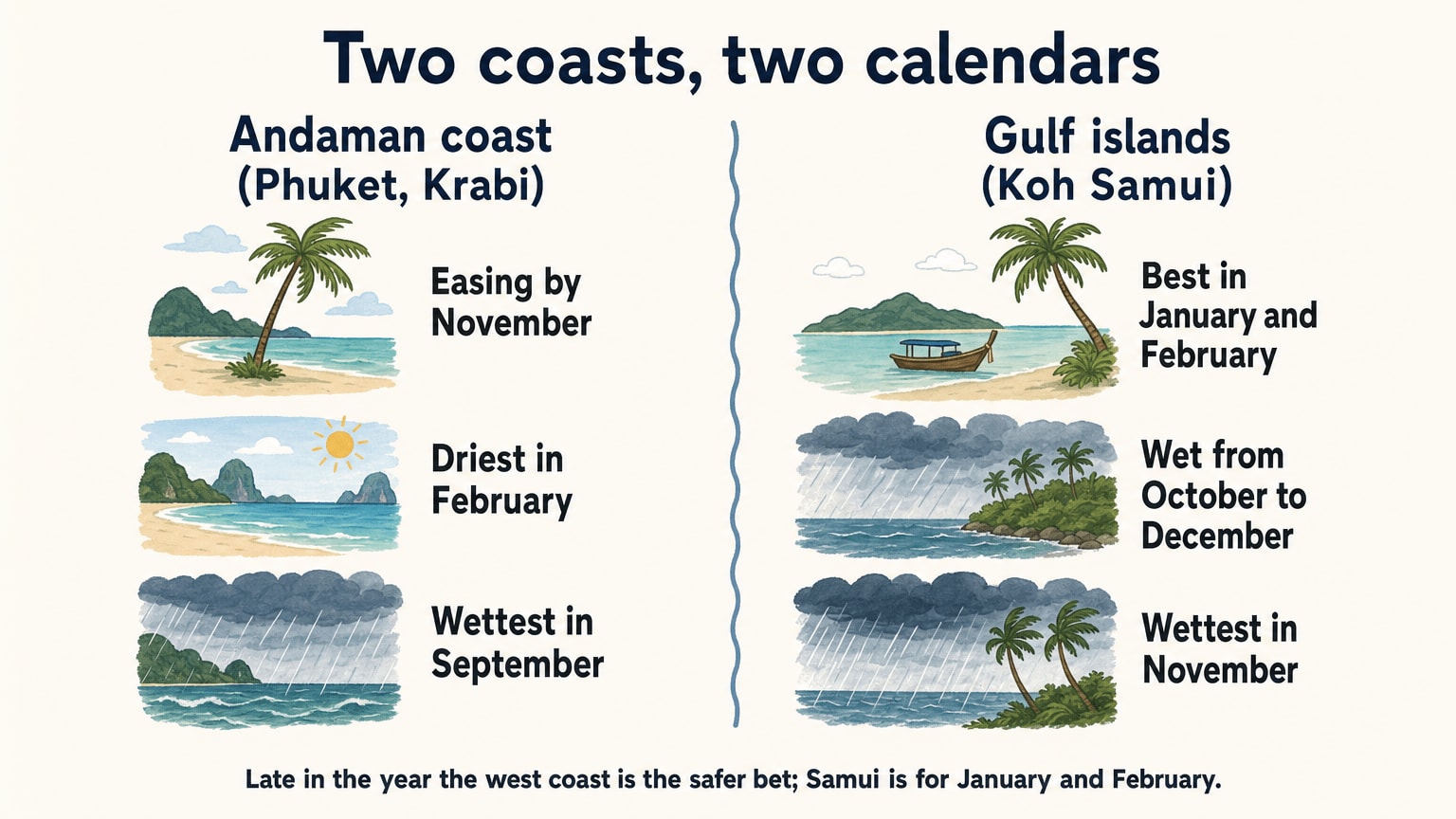
November. This is the swing month. Bangkok falls to 44.6 mm over 3.8 days, and Chiang Mai to 40.9 mm. Phuket is easing but still gets 178.2 mm over 12.9 days. Samui is at its wettest of the whole year, about 445 mm. The usual advice says the same: from October to December it’s wet in Samui and drier elsewhere.
December. Bangkok has 11.6 mm over a single rain day, the driest month in that table, with a high of 32.3 °C. Chiang Mai is dry at 14.1 mm and cool by day at 29.2 °C. Phuket gets 82.0 mm. Samui is at about 263 mm and still wet. December is also when Christmas and New Year pull the crowds, so the weather is good and the competition for rooms is stiff.
Season by season
If twelve months is too much to hold in your head, think in seasons. Thailand has three, not the four we know in Delhi, so I’ve said where summer, winter and autumn fit.
The seasons and what they usually bring, by place
| Season | Months | Bangkok | Phuket | Chiang Mai |
|---|---|---|---|---|
| Winter (cool season) | November to February | 11.6 to 44.6 mm a month, highs 32.3 to 33.7 °C | 24.0 to 178.2 mm a month | 9.6 to 40.9 mm a month, highs 29.2 to 32.9 °C |
| Summer (hot season) | March to May | 51.0 to 216.8 mm a month, highs 34.7 to 35.7 °C | 80.7 to 236.9 mm a month | 20.4 to 167.5 mm a month, highs 34.7 to 36.7 °C |
| Monsoon (rainy season) | June to October | 189.7 to 335.9 mm a month | 240.2 to 350.4 mm a month | 118.2 to 223.3 mm a month |
Source: the climate tables for Bangkok, Phuket City and Chiang Mai, 1991 to 2020. Phuket’s winter range includes November, which is still wet there.
Winter is the one most people mean by “the best time”. It’s dry and the heat eases a little. It’s also the busiest season, so book early. In the north, the first months are the good ones, before the smoke.
Summer is the hot season, with Bangkok at 35.7 °C in April and Chiang Mai at 36.7 °C. Rain returns through April and May, so May is hot and wet together. Songkran falls in this season, if you want the water festival.
The monsoon is the rainy season. Every place in the tables takes its heaviest rain here, with September the peak in Bangkok (335.9 mm) and Phuket (350.4 mm). Samui is the exception, as the coast section below explains.
Autumn, as such, doesn’t exist here. The nearest thing is September and October, the tail of the monsoon and the wettest weeks of the year in Bangkok and Phuket, then November, when the country swings towards the cool season. Bangkok and Chiang Mai are drying out by then, while Phuket is still at 178.2 mm and Samui is at its wettest. If you were picturing an Indian autumn trip, treat late November as the earliest sensible start. There’s no spring either. March and April, the hottest weeks, are the closest match.
Andaman coast and Gulf islands: they don’t share a calendar
This is the part most “best time” pages get wrong or skip, and it matters if you’re coming from Delhi in the winter holidays, which is when many of us travel.
Thailand has coast on two seas. The west side, with Phuket, Krabi and Phi Phi, faces the Andaman Sea. The east side, with Koh Samui and the islands round it, faces the Gulf of Thailand. They get their rain at different times.
Usual rain in mm, Andaman side (Phuket) against Gulf side (Koh Samui)
| Month | Phuket | Koh Samui |
|---|---|---|
| October | 336.0 | 295 |
| November | 178.2 | 445 |
| December | 82.0 | 263 |
| February | 24.0 | 64 |
Source: climate table for Phuket City; climate chart for Ko Samui. The Samui figures are read from a chart, so treat them as approximate.
Look at what that does to a November or December trip. Samui’s wettest month is November, and Phuket’s is down to about half of its October rain by then. Samui’s best time is January and February.
So for a trip in November or December, the west coast is the stronger bet. For a trip in January or February, either works, and Samui at its driest is lovely. Our Krabi post goes into the boats and bases on that coast, and its season advice lines up with the Phuket table.
What about the middle of the year? Samui’s chart shows roughly 100 to 135 mm a month from May to September, which is rain, but far less than the 236.9 to 350.4 mm that Phuket takes in those same months. That’s the one reason to pick Samui outside winter. I’d still ask the hotel what’s running before you pay. Boat days are the first thing a wet week cancels.
What the sea can do
I’d be careless to talk only about rain. Our regions post covers the west coast’s summer monsoon and its strong currents, and I don’t have a second source here, so I’ll only say this. “Can I swim?” is a different question from “will it rain?”. In the wet months the answer to the first can be no even on a bright afternoon. Obey the flags, and ask your hotel the same day.
The north, and the smoke nobody mentions
Chiang Mai has its own rule, and it isn’t about rain at all.
The burning season, February to April, causes severe smog from agricultural fires in Chiang Mai. Air quality often reaches hazardous levels and hides the mountain views. The table shows why February still looks perfect on paper: 9.6 mm of rain, the driest month of the year. Rain and air quality aren’t the same thing.
That makes the north’s sweet spot narrower than it looks. November to January is cool and dry (Chiang Mai’s high is 29.2 °C in December, and 30.0 °C in January), and the smog hasn’t started. The northern mountains can drop to about 5 °C, so a sweater matters if you’re hiking.
March and April are worse for two reasons stacked together. It’s the smoke season, and Chiang Mai hits 35.4 °C in March and 36.7 °C in April. If you’ve got elderly parents or small children, I’d avoid those two months for the north altogether.
And if you have to travel then? Put the beach first and the north second, or skip the north. The smoke is a risk, not a timetable. Some years it’s lighter. But I wouldn’t plan a Doi Suthep view around it.

Is the rainy season worth it?
It can be, if you picked it on purpose. When it rains in the wet season it pours, and flooding is not uncommon. So keep your plan flexible.
What you lose is easy to list. In Bangkok’s wettest month, September, there are 18.0 rain days out of 30. In Phuket in October there are 19.4. On the west coast the sea can be rough and boat trips can thin out. Ask what’s running. If your picture of the trip is a long-tail boat and a clear lagoon, this isn’t that trip.
What you get is, usually, fewer people and lower prices. That’s my expectation, not a figure. I couldn’t find a dated source for how much lower, so I won’t give you a percentage.
My view, flat: the rainy season is fine for Bangkok, for food, for markets and for indoor days. It’s a poor deal for a first beach holiday on the west coast. And May is the odd one out. It’s the first rainy month and also hot, with Bangkok at 35.1 °C. I’d skip it for older travellers.
Plan one thing and one spare. Do the outdoor part early and keep the afternoon for the mall, the museum or the massage. On the west coast, the sea might matter more than the rain.

Best time to go, by what you want
What you want, and the months that usually suit it
| What you want | Usual best months | The catch |
|---|---|---|
| Driest weather in Bangkok | November to February | Busiest; Christmas and New Year rooms are tight |
| West coast beaches (Phuket, Krabi) | November to April | Most crowded in the dry months |
| An island in January or February | Koh Samui | Its wet spell is October to December |
| Chiang Mai without smoke | November to January | February starts the burning season |
| Fewer people, lower prices | May to October, usually | More rain, and the west coast sea can be rough |
| Songkran water festival | Mid-April | Hot, crowded, and loud |
Source: the climate tables and season notes above
Now the people. Honeymooners, I’d go for January or February: dry in Bangkok, good on the west coast, and Samui at its best. The cool season is the most popular time to visit, and the crowds at the start of the year follow it. Book early for those weeks.
Families with school-age children need the school holidays, which in India means the May to June break and Diwali. May is hot and wet. October is the wettest month in Phuket’s table. So for a family trip, I’d pick the Bangkok-plus-Gulf-side combination in the summer holiday if you must go then, or hold the beach holiday for winter.
Older parents: November to January, and keep the north to the cool months. Bangkok in April is 35.7 °C by day, which is a lot to ask of anyone who tires easily.
Friends going for the nightlife: it’s the same cool-season window, but the beach is the one you’ll care about, so use the Phuket column.
Delhi holidays, fares and entry rules
This is the section the page-one guides skip for us. I wanted to give you a rupee calendar of flights and hotels by month. I couldn’t find a dated, checkable source for fares from Delhi, and I’m not going to make one up.
What I can say is how to find your own answer. Ask for quotes for two different months, with every line in rupees: flights from Delhi, the room, transfers, meals, entry fees and the visa. Compare line by line, not by the headline. Prices for flights and accommodation can be high around Christmas, New Year and Chinese New Year. I’d add Diwali and the May to June break to that list as my own expectation, not a figure. Ask whoever is quoting you whether your dates fall on a peak, and what the price would be a week earlier or later.
On entry rules, here are dates, because they’ve changed more than once. On 27 July 2026 the Royal Thai Embassy in New Delhi said the Cabinet had approved, on 14 July 2026, a 30-day visa exemption for Indian passport holders entering for tourism. Longer stays need an e-visa. All India Radio reported on 9 September 2026 that it applies from 15 September, with a passport valid for at least six months, confirmed return tickets, hotel bookings and the Thailand Digital Arrival Card within 72 hours before arrival. It also mentioned carrying at least 20 thousand Thai Baht in cash per passenger.
That’s a news report on top of an embassy notice, and rules like this can change again. Check the embassy site close to your date. VeeTrips offers visa assistance, but the government decides, not us.
A short plan for choosing
- Fixed dates? Find your month in the list above, then pick the coast that’s drier then.
- Going in November or December? Bangkok, Chiang Mai and the west coast. Leave Samui for January or later.
- Want the driest Bangkok? December, at 11.6 mm.
- Going to Chiang Mai? November to January, before the smoke.
- Going in March or April? Expect heat, and keep the days short.
- Rain doesn’t bother you and you want quiet? May to October, and ask what’s running.
- With parents or small children? I’d pick November to January, even if it costs more.
We’re a single-owner agency in Dwarka, so if your dates move you can call the office and speak to one person. I’d still pick the month first.
Frequently asked questions
What is the best month to visit Thailand?
December and January are the usual picks. Bangkok gets 11.6 mm of rain in December and 23.6 mm in January, with highs of 32.3 °C and 32.7 °C. They’re also busy, so book early.
What is the cheapest time to visit Thailand?
Usually the rainy months, when there are fewer people, though that’s my expectation and not a figure. I couldn’t find a dated source for fares or rooms by month, so I won’t give a number. Ask for two quotes and compare every line.
Is Thailand good to visit in the rainy season?
It can be, for Bangkok, food and indoor days. Bangkok has 18.0 rain days in September. On the west coast, strong currents and rough seas are the bigger worry. Don’t promise yourself a dry week.
When is the best time to visit Phuket or Krabi?
Roughly November to April, going by the Phuket table. February is the driest month at 24.0 mm, and September the wettest at 350.4 mm. Rough seas in the wet months can make swimming risky, so follow the flags.
When is the best time to visit Koh Samui?
January and February. Its wet spell is October to December, with November the wettest at about 445 mm, so it’s the wrong island for a November trip.
What is the hottest month in Thailand?
April, usually. Chiang Mai’s usual high is 36.7 °C and Bangkok’s is 35.7 °C. The hot season can reach 40 °C.
Is Chiang Mai smoky?
From February to April it can be. There’s severe smog from agricultural fires that can hide the mountain views. November to January is the safer window.
Do Indians need a visa for Thailand?
An embassy notice dated 27 July 2026 and a 9 September 2026 news report describe a 30-day exemption for Indian tourists from 15 September 2026. Rules have changed before, so check the embassy site before you fly.