
Best time to visit Maldives: February to April, usually
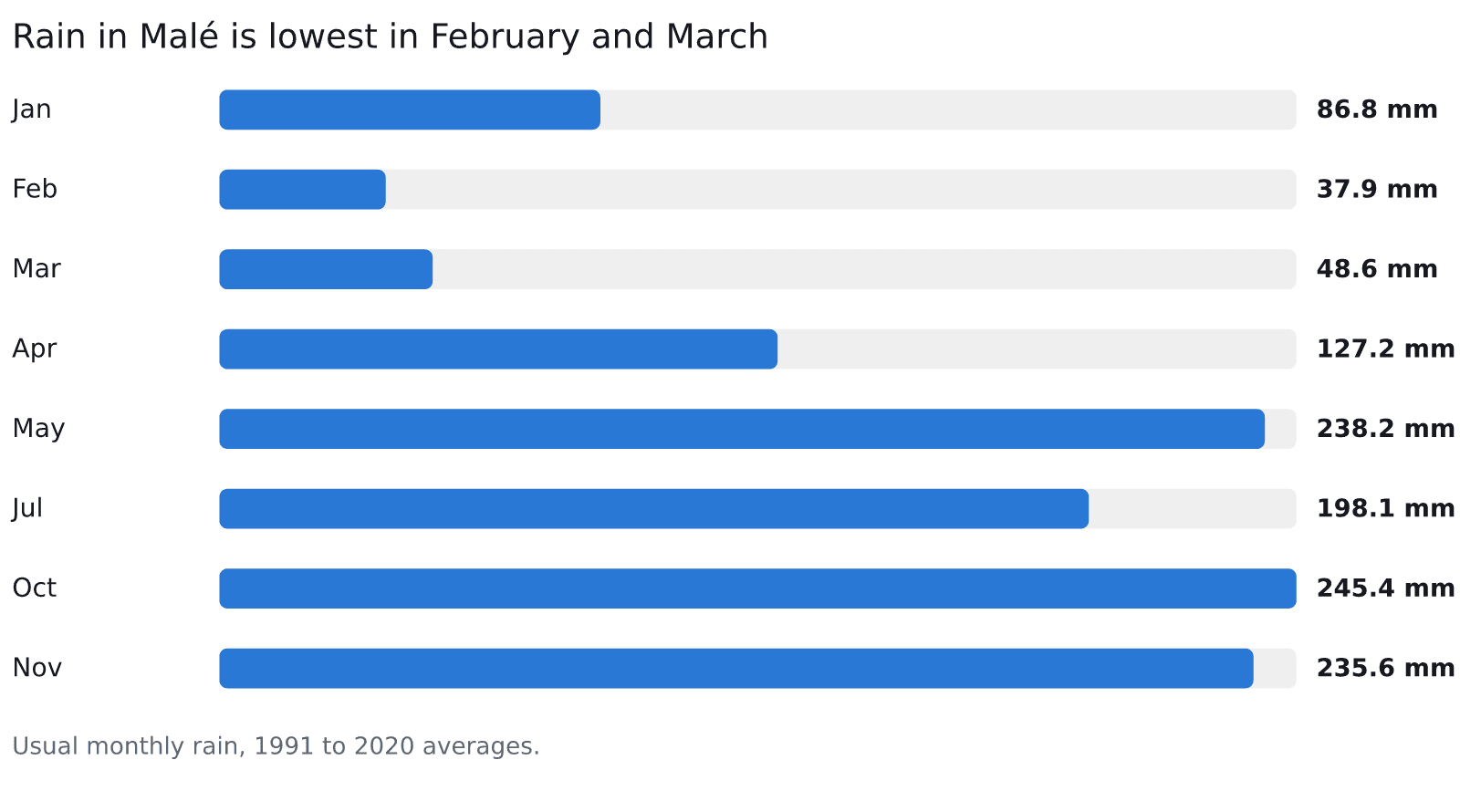
In short: The best time to visit Maldives is usually February to April. February and March are the driest months in Malé, at 37.9 mm and 48.6 mm of rain. May to November is wetter, and it’s manta season.
You’ve got a week free, or a honeymoon date, and one friend says “never go in the monsoon” while another says “we went in July and it was lovely”. Both can be true. The Maldives doesn’t have a washed-out month the way Goa has July. It has a drier stretch and a wetter one, and the gap is smaller than people think.
If you want the hotel, transfers and sightseeing sorted in one place, VeeTrips lists a Delhi-departure Maldives package with the inclusions spelled out. Pick the month first, though. That’s what the rest of this page is for.
The year in one table
Here are the usual temperatures and rain for Malé, taken from a climate table for Malé, which uses the 1991 to 2020 averages from Velana International Airport. They’re averages for one spot. Any given week can run wetter or drier, and I won’t promise you a particular day.
Usual daily high and rain in Malé, selected months
| Month | Usual high (°C) | Usual low (°C) | Rain (mm) |
|---|---|---|---|
| January | 30.6 | 26.0 | 86.8 |
| February | 31.0 | 26.3 | 37.9 |
| March | 31.6 | 26.8 | 48.6 |
| April | 31.9 | 27.1 | 127.2 |
| May | 31.5 | 26.6 | 238.2 |
| July | 30.8 | 25.9 | 198.1 |
| October | 30.5 | 25.7 | 245.4 |
| November | 30.4 | 25.5 | 235.6 |
Two things jump out. First, the heat barely moves. Highs run from 30.4 °C to 31.9 °C all year, and even the nights sit above 25 °C. So temperature won’t help you choose. Rain will. If heat is what decides your month, our best time to visit Dubai page is the one where it does.
Second, there’s no month with zero rain. The whole year adds up to 1,983 mm, and the driest month, February, still gets 37.9 mm. In the Maldives you’re choosing between less rain and more rain, not between dry and drowned.
The two seasons, in plain words
The Maldives runs on two monsoons. The dry northeast monsoon gives way to the wet southwest one in April and May. The southwest monsoon usually reaches the Maldives at the beginning of June and lasts until late November.
That gives you a rough calendar. December to April is the drier side, with the best of it in February and March. May to November is the wetter side. Most travel pages call the dry stretch peak season and the wet one low season, and that matches what I’d expect, but I couldn’t find a dated source for how much prices move, so I won’t give you a percentage. More on that below.
Here’s the catch that most “dry season is November to April” pages skip. November is still wet in Malé. The table says 235.6 mm, which is close to October’s 245.4 mm, and December is 212.2 mm. If a page tells you November is the start of the dry season, the airport data says the dry weather arrives later than the label does. January is better at 86.8 mm, and February is the real change.
Month by month
Here are all twelve, from the same Malé table. Usual high first, then rain.
January (30.6 °C, 86.8 mm) is the start of the proper dry stretch. The best scuba diving is usually January to April, when the sea is calm and visibility can reach 30 m.
February (31.0 °C, 37.9 mm) is the driest month in the table. If you can only pick one month and the weather is everything, this is it. It’s also the one I’d expect to be busy.
March (31.6 °C, 48.6 mm) is almost as dry and a little warmer. April (31.9 °C, 127.2 mm) is the hottest month in the table, and the rain starts to come back as the monsoon shifts.
May (31.5 °C, 238.2 mm) is where the wet side really begins. It’s the first month that gets above 200 mm.
June (31.1 °C, 146.1 mm) is oddly lower than the months on either side of it. Don’t read much into that. It’s one airport’s average, and the southwest monsoon is officially in by then.
July (30.8 °C, 198.1 mm) and August (30.7 °C, 193.2 mm) are close to each other. The biggest surf waves usually come in June, July and August, so if you surf, these are your months.
September (30.5 °C, 213.7 mm) and October (30.5 °C, 245.4 mm) are the wettest stretch in the table, with October the wettest of all.
November (30.4 °C, 235.6 mm) is still wet, as above. December (30.4 °C, 212.2 mm) eases a little, and it’s the month Christmas and New Year pull in the crowds.

North or south: does it matter?
A bit. Annual rainfall averages 254 centimetres in the north and 381 centimetres in the south. That’s a big gap on paper, and it means the south is the wetter half of the country.
I need to be honest about the limit here. Malé is in Kaafu Atoll, and its table is the only month-by-month one I could read. I don’t have monthly figures for the far north or the far south. A Maldives season calendar says southern atolls see more rain in the wet season, and names Laamu, Fuvahmulah and Addu as examples. That matches the annual numbers.
What does it mean for you? If you’re booking in May to November and rain bothers you, a resort in the north or around Malé is the safer guess than one in the deep south. If you’re booking in the dry months, the difference matters much less. Ask the resort which atoll it’s in before you compare weather, because “Maldives” is not one climate.
If you’re still choosing where to stay, our page on Maldives places to visit sorts the islands by trip style.

Is the monsoon worth it?
It depends what you wanted from the trip, and I’d rather say that plainly than give you a cop-out.
What you lose: calm. The same season calendar describes the wet months as humid, with short showers and stronger winds, and calls June to October the peak of the wet season, with the highest chance of rain and wind. Rain, wind and waves are most common from June to November, and the best diving window is January to April. If your picture is flat blue water and a clear sky every day, the dry months give you the better odds. Not a guarantee. Nobody can promise one.
What you get: the mantas. Maldives Magazine’s manta guide puts the peak season at Hanifaru Bay from June to November, with the absolute peak from late July to October. Hanifaru Bay, in Baa Atoll, regularly sees some of the largest gatherings of manta rays worldwide, and it happens when the tide pushes plankton into the bay. So the sea life is at its best just as the weather is at its worst.
My view: the monsoon is worth it if you picked it on purpose. A couple who want the reef, a slow week, and a lot of time under a roof with a book will be fine. A first-time honeymoon where the whole point is the photo on the jetty is better off in the dry months. And whatever you pick, don’t plan one outdoor day as the only day that matters. Keep a spare.

Best time by what you want
What you want, and the months that usually suit it
| What you want | Usual best months | The catch |
|---|---|---|
| Driest weather, calm sea | February and March | Busiest, and the least rain in Malé is still 37.9 mm |
| Diving | January to April | Calm sea and up to 30 m visibility |
| Mantas at Hanifaru Bay | June to November | Wet and windy; the bay needs a permit |
| Surfing | March to October | Biggest waves in June, July and August |
| Fewer people | May to November | More rain, more wind |
Source: Maldives Magazine
Honeymoon first, since many of you are reading for that. If it’s a once-only trip and you want the postcard, I’d aim for February or March, and book early. If you’d rather have a quieter beach and can live with showers, May or June is a fair gamble. Whichever you choose, ask about the room, the transfer and the meal plan before you ask about the view.
Families with small children: I’d go in the dry months. A child who can’t get in the sea for three days because the wind is up is not a happy child. Calm water suits parents who like a slow pace, too.

Divers: the sea is calmest from January to April, and that’s your window. Snorkellers who care about mantas: June to November. These are different calendars, so decide which one you’re booking for.
Whale sharks I’ll leave open. Travel pages disagree on months, and most of them are sold by operators. The manta guide I read gives no whale shark season at all. Ask a dive centre in the atoll you’re considering, and trust a month they can name for their own water.

Cost, and the Indian holiday peaks
This is the part page-one guides skip for readers in India. I wanted to give you a rupee calendar: Delhi to Malé flights and resort nights, month by month, with Diwali, Christmas and the May to June school break marked. I couldn’t find a dated, checkable source for that, so I’m not going to make one up.
What I can say is how to find the real answer. Ask for quotes for two different months, with every line in rupees: flights from Delhi, the room, the transfer to the island, meals and the visa. Then compare line by line, not the headline. Our Bali package page shows what that line-by-line reading looks like. The transfer is the line that surprises people. A resort transfer by speedboat or seaplane can cost real money, so make sure it’s in the package or clearly outside it.
Dates tied to Indian holidays are the ones I’d check first. Diwali, the Christmas to New Year week and the May to June break are when many families travel, and I’d expect any beach destination to cost more on those days. That’s my expectation, not a figure. Ask the person quoting you whether your dates fall on a peak, and what the rate would be a week earlier or later.
Booking lead time and the visa
I don’t have a source for how far ahead to book, so I won’t give you a number of weeks. The honest rule: the fewer flexible dates you have, the earlier you ask. Christmas and New Year week is the one I’d lock first.
On entry rules, read the source, not a blog. The Maldives Immigration tourist visa page, marked updated 10/09/2026, lists a passport with at least 1 month’s validity, a complete itinerary with confirmed return tickets, and a Traveller Declaration within 96 hours before arrival. It did not give me a visa length or fee for Indian passports, so I can’t tell you either. Rules change. Check the page again before you fly, and ask us about visa assistance if you’d like a hand with the forms.
A short plan for choosing
- Fixed dates? Choose from what’s left on the table above.
- Want the driest weather? February or March.
- Diving? January to April.
- Mantas? June to November, and Hanifaru needs a permit through a resort or operator.
- Rain doesn’t bother you, and you’d like fewer people? May to November, in the north or near Malé.
- Travelling with parents or small children? I’d pick the dry months, even if it costs more.
We’re a single-owner agency in Dwarka, so if your dates move you can call and speak to one person. I’d still pick the month first.
Frequently asked questions
Which month is best to visit the Maldives?
February is the driest month in Malé, at 37.9 mm of rain, with March next at 48.6 mm. Both are usually calm and bright. They’re also busy, so book early.
Is it worth visiting the Maldives in the monsoon?
It can be, if you want the reef and a slow trip. The southwest monsoon usually runs from early June to late November. The rain is steadier than in the dry months and the wind is stronger. Mantas gather at Hanifaru Bay from June to November.
Is December a good time for a Maldives honeymoon?
It’s a popular one, but December in Malé still averages 212.2 mm of rain, so don’t expect a perfectly dry week. January (86.8 mm) is usually better. Christmas and New Year week is the busiest, so ask for exact rates.
When is the best time for diving in the Maldives?
January to April, when the sea is calm and visibility can reach 30 m. Diving is possible all year, but rain, wind and waves are most common from June to November.
When can you see manta rays in the Maldives?
At Hanifaru Bay the peak is June to November, with the absolute peak from late July to October, says Maldives Magazine. Nobody can promise a sighting. Hanifaru needs a permit.
Is the Maldives hot all year?
Yes. Usual highs run from 30.4 °C to 31.9 °C and nights stay above 25 °C. The difference between seasons is rain and wind, not heat.
Is the south of the Maldives wetter than the north?
Yes. Annual rainfall averages 381 centimetres in the south and 254 centimetres in the north. Ask which atoll a resort is in before you compare weather.