Singapore language in one answer
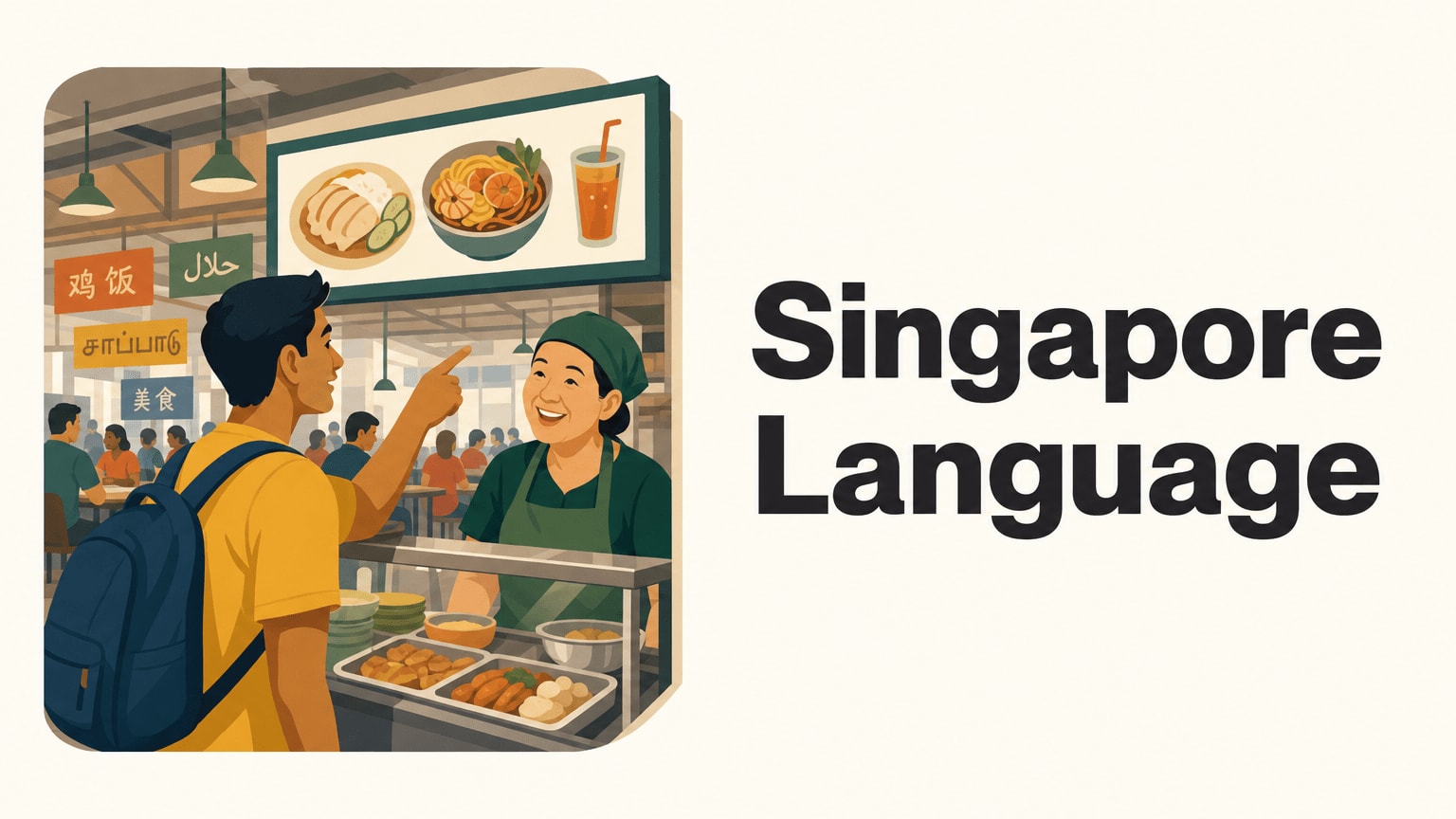
In short: Singapore has four official languages: English, Mandarin, Malay and Tamil. English is the one you will use. In the 2020 census, 48.3% of residents said it was the language they spoke most at home.
Guides say “English, Mandarin, Malay and Tamil” and stop there, which doesn’t tell you what to do at a counter or a food stall. That isn’t your fault. A list of official languages and a street are two different things.
If you want the hotel, transfers and sightseeing sorted in one place, VeeTrips lists a Delhi-departure Singapore package with the inclusions spelled out. Language won’t be the hard part of the trip, though, so the rest of this page is about what you will actually hear.
I’ll go in the order a visitor meets things. First the four languages and what each one is for. Then Singlish, because that’s the sound you’ll notice first. Then the one that matters most to a reader from India, which is Tamil. Then phrases, and a short list of what to check before you fly.
One honest note first. I wanted the census numbers from Singapore’s own statistics office, and its pages wouldn’t open for me. So the percentages below come from a reproduction of the 2020 census, not the original. Where I couldn’t confirm something, I’ve left it out.
The four official languages, and what each is for
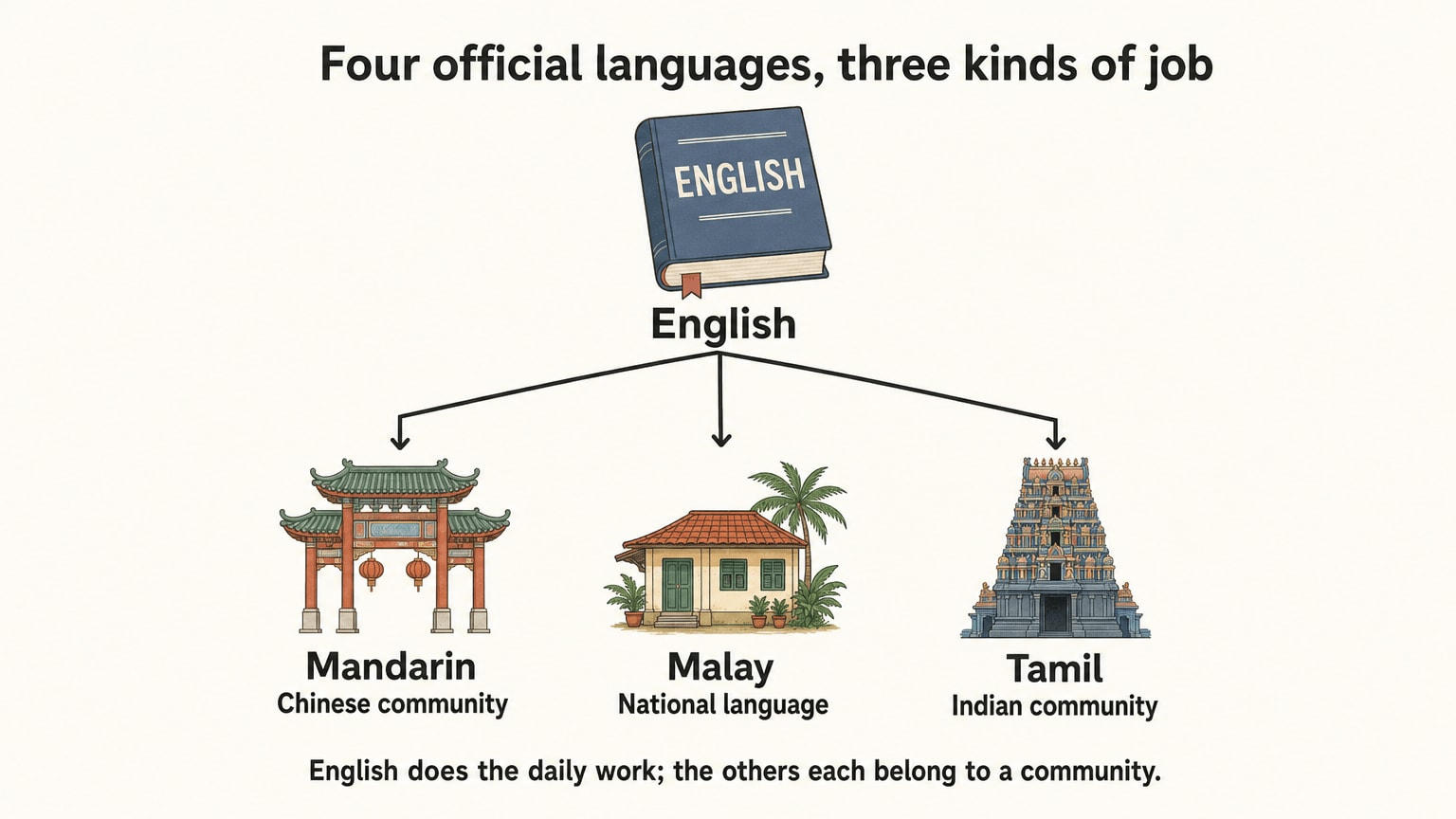
The Languages of Singapore page says: “The official languages of Singapore are English, Mandarin Chinese, Malay and Tamil.” Malay is the national language. English is the de facto main language in daily, government, legal, trade and commercial affairs.
That’s three jobs for four languages, and it’s worth separating them.
What each official language does
| Language | Its job | What a visitor notices |
|---|---|---|
| English | Daily life, government, law, business | Spoken almost everywhere you’ll go |
| Mandarin | The designated mother tongue of Chinese Singaporeans | The second most common home language |
| Malay | The national language | Mostly ceremonial, per Expatica |
| Tamil | Official language, the Indian community’s main mother tongue | Signs and Little India |
Source: Expatica
Malay is the odd one. It’s the national language, yet Expatica calls its position “mainly ceremonial”. The details back that up: Malay is in the national anthem, in the citations for Singapore’s orders and decorations, and in military foot-drill commands. So you hear it at a parade, not at a taxi stand.
So here’s the plain version. Four languages are official on paper. In practice one of them does most of the work, and the other three each belong to a community.
What people speak at home
Official status tells you what the law says. The census tells you what happens in a kitchen.
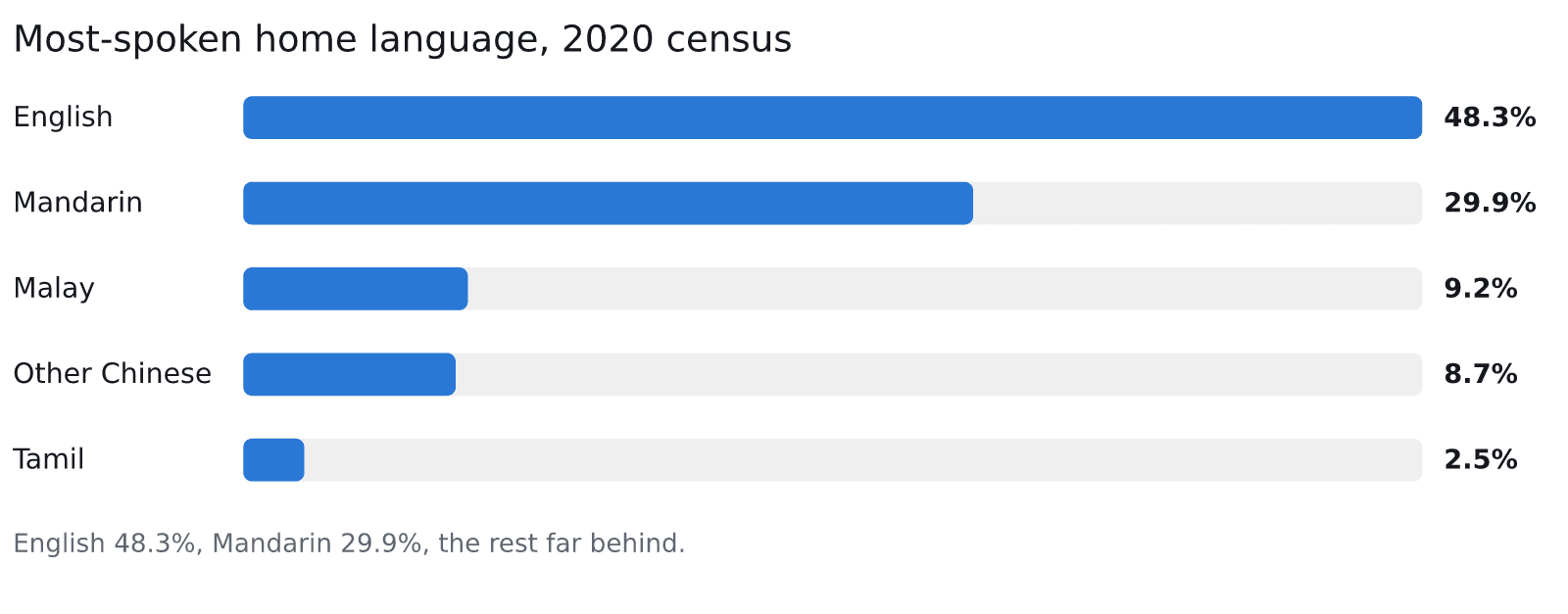
The 2020 census figures below are for the language residents most often speak at home. I’m taking them from a page that reproduces them, because the statistics office’s own files wouldn’t load.
Language most often spoken at home, 2020 census
| Language | Share |
|---|---|
| English | 48.3% |
| Mandarin | 29.9% |
| Malay | 9.2% |
| Other Chinese varieties | 8.7% |
| Tamil | 2.5% |
| Others | 1.4% |
Add the Chinese rows and you get 38.6%, which the page also states. So Mandarin and the other Chinese varieties together come second to English.
Tamil is at 2.5%. Don’t read that as “Tamil is rare in Singapore”, though. It’s a share of everyone, and Tamil is the home language of one community. Expatica puts it this way: it’s the least spoken of the official languages today, except among ethnic Tamils.
One more thing you’ll see on that page. Its table has a later column too, with English at 58.1% and Tamil at 2.2%, and the page’s own Tamil text and table don’t agree with each other. I couldn’t tell which is right, so I’ve kept to the 2020 census figures and I’d treat any single percentage as a rough shape, not a fact to quote at a dinner.
How to read a census table without being fooled
Language figures look exact and aren’t. Here is what I’d keep in mind, since you’ll see these numbers quoted in a dozen places.
First, “most often spoken at home” is not “spoken”. A person who speaks English at work, Hokkien with a grandmother and Mandarin with a neighbour appears in the table once, under one of them. So a small share doesn’t mean few speakers. It means few households where that language is the main one.
Second, “mother tongue” is a different thing again. The Languages of Singapore page says that since 1 January 2011 a student’s Mother Tongue is defined by their official registered race, where before it followed the father’s ethnicity. A child’s registered Mother Tongue can therefore differ from what they speak at home.
Third, sources differ. I found the 2020 home-language table, the 2010 group figures and a few earlier years, and they are not always built the same way. The page I read gives Mandarin as 29.9% of all residents in 2020 and as 40.2% of Chinese residents, and both are right, because the denominators are different. The 2010 Tamil figure, 36.7%, is a share of Indian Singaporeans, and the 2.5% is a share of everyone.
Fourth, the census is a snapshot from a particular year. The next one will move the numbers, and the English share in particular has risen census after census. The Singapore English article says English as the most often spoken home language rose from 18.8% in 1990 to 48.3% in 2020.
Three ways the same census can mislead
| Trap | What to do instead |
|---|---|
| Home language read as “who can speak it” | Read it as “what the household mainly uses” |
| Share of everyone mixed with share of one community | Check the denominator first |
| One year treated as permanent | Look at the trend, and date the figure |
A short history of why there are so many
The simplest answer to “why four?” is trade and migration. The Singapore English article says the British set up a trading post in 1819, and that Singapore stayed a British colony until 1963, apart from the Japanese occupation from 1942 to 1945. Traders and workers came from southern China, from India, and from the Malay world, and each community brought its own languages.
English-medium schools in the nineteenth and early twentieth centuries gave Singapore English its local character. The article says the teachers came from India, Ceylon, Europe and the US, and by 1900 Eurasians and other locals were teaching too. So there has been an Indian presence in Singapore’s English classrooms for a very long time.
After independence in 1965, the government kept English as the main language. The article gives two reasons: to support economic growth, and to serve as a common language across ethnic groups. That’s the same logic Lee Kuan Yew is quoted as using for Mandarin among Chinese Singaporeans. A common language inside each community, and English between them.
The article says about 4 million people are native speakers of English, per the 2020 census. That’s the number to hold alongside the percentages. It’s a lot of people, and many of them learned English before any other language.

Peranakans and Eurasians
Two small communities deserve a line. The Peranakans spoke Baba Malay, which the Singlish article calls a creole of Malay and Hokkien, spoken by wealthy Peranakans. The Eurasian community speaks Kristang, a creole developed from Portuguese. The Languages of Singapore page says that after the British took over Singapore, Portuguese Eurasians learned English and Kristang declined. As of 2006 it was largely spoken by the elderly.
For a visitor, these are not things to look for. They are a reminder that the four official languages are a modern tidy-up of a much more crowded picture.
English: what you will actually use
If you only remember one thing from this page, make it this one. You can get by in English.
One travel guide I read says English is spoken by almost every non-elderly Singaporean, with varying degrees of fluency. It adds that government offices must serve people in all four official languages. That’s useful if you ever need an office. Most visitors never do.
Spelling is the British kind, according to the Singapore English article: “Spelling in Singapore largely follows British conventions”. So a reader from Delhi who learned “colour” and “centre” at school will feel at home on a menu board.
Notice what I haven’t said. I haven’t said every person you meet will speak fluent standard English. The guide says “varying degrees”. An older stallholder may manage a few words. A teenager at the mall may speak the way they speak with friends, which is Singlish. Both can be understood if you slow down and keep your sentences short. That’s the same trick you’d use on a call with a bad line.
I couldn’t find a trustworthy source on how well English works in every setting, such as small shops, older taxi drivers or hospitals. So I won’t promise you that. Keep your hotel address on your phone, written out, and keep the name of the area too. That’s my advice, not a sourced fact, and it costs you nothing.
Singlish: the sound you’ll notice first
You’ll hear it within the first hour. It sounds like English, but the rhythm is different, and words you don’t know turn up at the end of sentences.
The Singlish article describes Singlish as an English-based contact language from Singapore, and as an informal register of Singapore English. It grew out of contact between speakers of Malay, Hokkien, Cantonese, Teochew and English, with some Tamil. Most loanwords come from Malay and Hokkien. Scholars disagree on whether to call it a creole.
How many people use it? A 2018 Institute of Policy Studies study found that 8% of Singaporeans identify Singlish as their primary language, per that article. About one-third say English is their primary language. Those are small numbers, and they miss the point. Many people who call English their main language still switch into Singlish with friends. The article notes that most surveyed Singaporeans preferred Singlish when talking with other Singaporeans.
The government hasn’t always been fond of it. The Speak Good English Movement began in 2000 as an annual campaign to encourage standard English. The Singlish article says it first called Singlish “bad English”, and that by 2016 the campaign had shifted towards encouraging Singlish speakers to learn standard English too and to keep the two apart. The language is still going.
The small words at the end of sentences
The most famous feature is the particle: a tiny word stuck on the end of a sentence. The Singlish vocabulary page defines a few.
Sentence-end words and what they do
| Word | What it does | Where it comes from |
|---|---|---|
| lah | An exclamation at the end of a sentence, pronounced differently in questions | Cantonese |
| lor | Used like lah, signalling the point should be obvious | Cantonese |
| leh | Used like lah, to stress the sentence | Hokkien |
| can | A question and an answer: “Can?” “Can.” | Not given |
Expatica says lah turns up in almost every sentence, adding emotional emphasis. The vocabulary page notes that lah was included in the Oxford English Dictionary’s debut in March 2000. So it’s not slang that’s going away.
The one you’ll need on day one is “can”. Ask a stall owner “Can?” and “Can.” means yes. It’s the single most useful Singlish word for a visitor, and you don’t have to say it back if you don’t want to. A nod works.
A few more particles, and how to read them
The vocabulary page lists more than the four in the table. Here are three that show up in conversation, with the page’s own definitions.
More sentence-end words
| Word | What it does |
|---|---|
| ah | Written “ar” at times; expresses doubt at the end of a sentence, and most speakers prefer it at the end of questions |
| meh | Tagged on a negative question, for example when someone is looking at a possible loophole |
| mah | Tagged on the end of a sentence to seek agreement or to argue a point |
You don’t need to use any of these. The reason to know them is that they carry mood. A sentence that ends in “meh” is a doubtful question, and a sentence that ends in “mah” is someone defending a point. If you hear a short sentence that sounds sharp, it may be neither angry nor rude. The particle changes what it means.
Expatica gives one exchange I like. Someone asks “Can or not?” and the reply is “Can, lah”, which means yes. It’s the same pattern as “Can?” and “Can.” that I mentioned. Notice that the answer repeats the verb. That’s very common in Singlish and in several of the languages feeding it.
Words you’ll see on menus and hear in queues
Here are some you might meet, all from the same vocabulary page.
Singlish words a visitor is likely to hear
| Word | Meaning | Origin |
|---|---|---|
| makan | To eat | Malay |
| kopi | Coffee | English, Malay and colloquial Tamil |
| tapao | Takeaway, for cooked food only | Cantonese |
| chope | To reserve a seat | Malay and Hindi, via “chop” |
| shiok | Sheer delight, especially about good food | Punjabi and Malay |
| paiseh | Embarrassed | Hokkien |
| kiasu | Literally “afraid of losing” | Hokkien and Teochew |
| jialat | In trouble, a terrible situation | Hokkien and Teochew |
| sian | Bored, tired, sick of something | Hokkien and Teochew |
| alamak | Shock, surprise or dismay | Malay |
Two small surprises there for a reader from India. “Chope” comes, via English “chop”, from the Malay word cap, which traces back to the Hindi word chhaap. And “shiok” is listed as Punjabi and Malay in origin. You’ll hear Indian words in that list, and “aiyah”, for “oh no”, is listed as Chinese or Tamil. The page gives the Tamil version as aiyo.
Kiasu was added to the Oxford English Dictionary in 2007, per the Singlish article. So a word from Hokkien and Teochew now sits in the Oxford English Dictionary.
The vocabulary page adds that “ang moh”, a term for people of European descent, can be found mildly derogatory by some. You’ll probably overhear it. I’d listen and not repeat it.
Should you try it yourself?
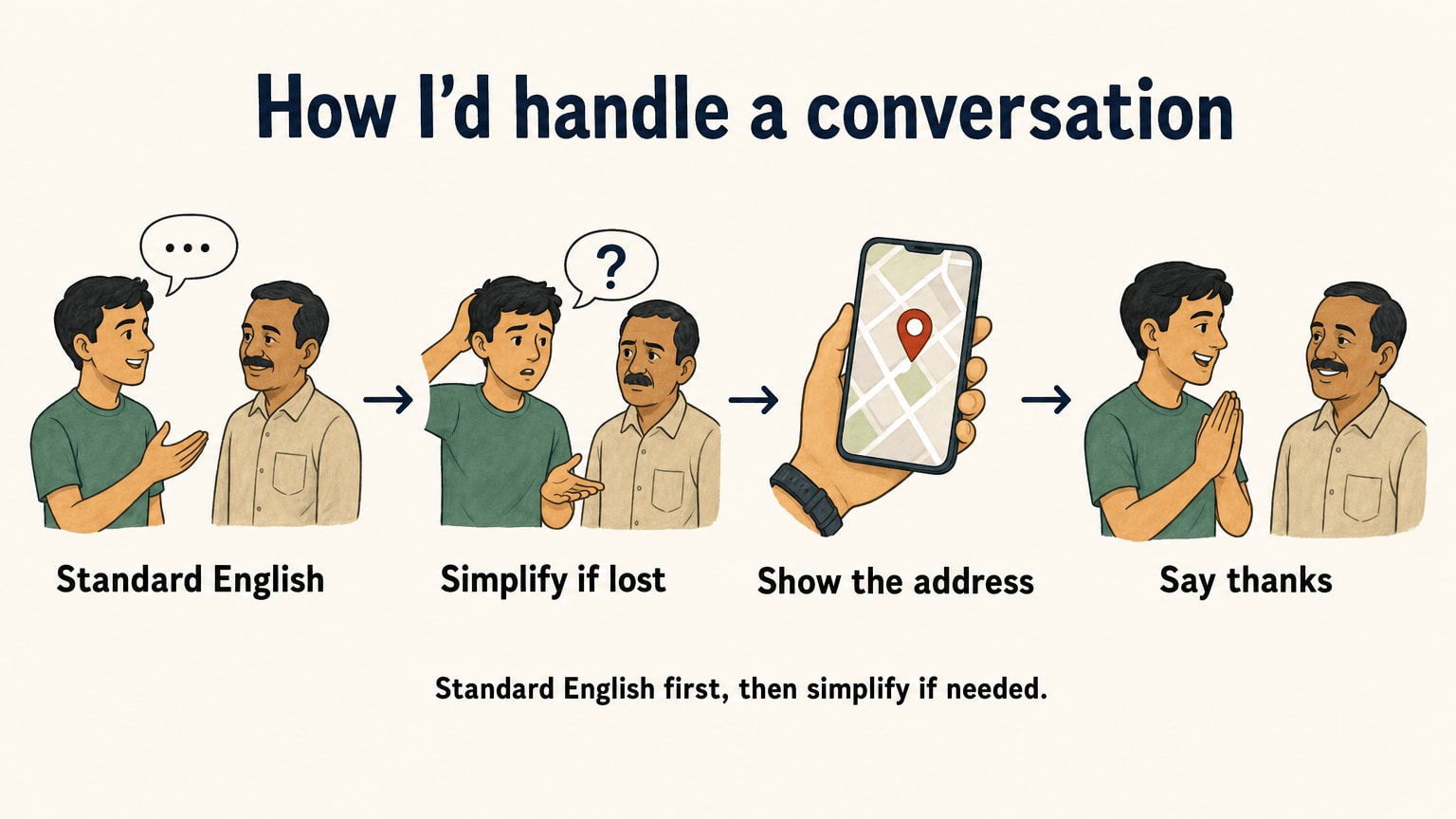
The travel guide has a clear view, and I agree with it. It says: “it’s best to start off with standard English”. It suggests shifting to simplified pidgin only if it becomes evident the other person cannot follow you. And it warns you to resist the temptation to sprinkle your speech with unnecessary Singlish words.
That’s the right instinct. A visitor who says “can lah” in the first sentence is performing, and people notice. Say “thank you”, say it plainly, and let them use the particles. If a Singaporean friend teaches you one, use that one.
Where Singlish came from, and how it sounds
A visitor can enjoy Singlish without knowing any of this. But it explains why the same person can sound so different at a meeting and at a hawker stall, and I find that more useful than a list of slang words.
A short history
The Singlish article starts before English arrived. Baba Malay, a creole of Malay and Hokkien, was spoken by wealthy Peranakans. Bazaar Malay, a pidgin, was used between ethnic groups who had no other language in common. So Singapore was already a place where people mixed languages to do business.
Then the British came, and in the 1830s English-language education was established. At first it was dominated by Baba Malay and Kristang speakers. Over time other groups joined. English became a native language for some families from the 1930s, starting with girls’ access to English schooling. In 1955 English-medium education overtook Chinese-medium education, and by 1984 all schooling was in English, except in foreign community schools.
That timeline matters. A child in a 1984 classroom learned English from a teacher and Hokkien or Malay from a grandmother, and Singlish is what you get when both are in the same head.
The word itself is younger than the thing. The article says “Singlish” first appeared in print on 20 July 1975, in the New Nation. And in August 1993, Singlish advertisements on radio and television were banned. I’ll come back to what has changed since.
Dates in the making of Singlish
| Period | What happened |
|---|---|
| 1830s | English-language education is established |
| 1955 | English-medium education overtakes Chinese-medium education |
| 1975 | “Singlish” first appears in print, in the New Nation |
| 1984 | All schooling is in English, apart from foreign community schools |
| 1993 | Singlish advertisements banned on radio and television |
| 2000 | The Speak Good English Movement is launched |
| 2016 | The movement softens its stance on Singlish speakers |
How it sounds
You don’t need grammar to hear the difference, but it helps to know what you’re listening for. The article lists the features of Singlish: topic prominence, omission of “be”, reduplication and discourse particles. It lists the features of standard English too: inversion of subject and auxiliary in questions, inflections for nouns and verbs, and complex verb groups with modal auxiliaries. Singlish tends to leave those out.
What does that mean at a counter? Omitting “be” means someone may say “this one very nice” and not “this one is very nice”. Reduplication means a word is said twice for emphasis. Topic prominence means the thing being discussed comes first, and the comment on it follows. None of these is an error. They’re the rules of a different variety.
The sound is different too. The article says Singlish is built on British English, is heavily influenced by Malay, Hokkien and Cantonese, and is syllable-timed. That means each syllable gets about the same beat, where British English stretches some syllables and squashes others. If you’ve ever noticed that Indian English also has a steadier beat than British English, you’ll find this familiar. I’m saying that from listening, not from a source, so treat it as my impression.
Some specific sounds are worth knowing, because they’re why you might not catch a word. Before a vowel, the “th” sounds become “t” and “d”, so “thin” sounds like “tin”. After a vowel, “th” can become “f”, so “birth” sounds like “birf”. A final “l” is often pronounced further back in the mouth, so “mall” and “more” can sound alike. The article adds glottal stops before words that begin with a vowel, and shortened consonant clusters.
The practical advice is dull but true. If you can’t understand a word, ask for it again, or ask the person to point. Nobody minds. The same article says careful speech keeps the standard forms, so a person speaking carefully to a visitor will often sound more standard than they do to their friends.
What Singaporeans think of it
The article’s section on attitudes gives 2024 survey figures. It says 71.1% said Singlish is appropriate with friends. It says 60.1% said it is inappropriate in governmental speeches, and 57.6% said it is inappropriate for teachers to use it in class. The same figure, 57.6%, is given for emails.
So Singaporeans are not confused about when to use it. It’s a language of friends, queues and food courts, not of a speech or a classroom. The article also says an increasing majority regard Singlish as a national identity, with Indians least likely to agree, and that younger Singaporeans were most comfortable using it. I don’t know why Indians were least likely to agree, and the page gives me nothing to explain it, so I won’t guess.
In 1993 the state banned Singlish adverts. In 2016, the Speak Good English Movement had adjusted its stance. In between, the language stayed in use. That’s the picture I’d give a visitor: official unease, everyday affection, and a clear sense in most speakers of when to switch.
Standard Singapore English
One more piece, which most pages on this topic skip. The Singapore English article separates Standard Singapore English from Singlish. Standard Singapore English is the formal variety. Its grammar and spelling are close to British English, and it’s what people use at work and with authority figures. The article calls Singlish the informal end, with particles, loanwords from Malay, Mandarin and Hokkien, and the dropped “be”.
Many Singaporeans move between the two depending on the room. The article adds that better-educated speakers tend to use the standard form, and speakers whose first language isn’t English tend to use Singlish. The accent in the standard form is based on non-rhotic southern British English, so the “r” in “far” is usually dropped. Listen for it.
A few words differ from what you’d see in a British dictionary. The article gives “brinjal” for aubergine. India uses that word too, so that one will make you smile. It also gives “void deck”, the ground floor of a public housing block, which is a place you’ll see and may not need to name.
How much English is there? The article says English as the language most often spoken at home rose from 18.8% in 1990 to 48.3% in 2020. That’s a big shift in one generation, and it explains why English works so well for a visitor now.
Mandarin and the other Chinese varieties
About three in four people in Singapore are ethnically Chinese, according to Expatica’s figure of roughly 75%. So you’d expect a lot of Chinese, and you hear it. But “Chinese” covers several languages, and Singapore made a choice about which.
One page I read says that in 1979 the government “heavily promoted Mandarin” through the Speak Mandarin Campaign. Lee Kuan Yew said Mandarin was chosen to unify the Chinese community under a single language. Television and radio programmes in other Chinese varieties were replaced with Mandarin programmes.
Before that, people spoke different varieties that didn’t understand each other. Expatica notes that earlier immigrants mostly spoke Cantonese, Hokkien and Hainanese. The same page says Hokkien was once a lingua franca and an unofficial language of business until the 1980s. It still accounts for about half of non-Mandarin Chinese speakers. Cantonese has held on, partly because of Hong Kong media. Teochew, the page says, is being replaced by Hokkien.
What this means for you is simple. You won’t need any of them. But if you hear a conversation that sounds nothing like the Mandarin you know from films, it may be Hokkien or Cantonese, and that’s normal.
Written Chinese
The Languages of Singapore page says traditional characters were used until 1969, when the Ministry of Education issued a Table of Simplified Characters. A new table followed in 1974, and a revision in 1976 removed all differences from the simplified characters used in China. Simplified characters are used in official documents. Traditional characters remain common on signs, advertisements and calligraphy.
I’ll note a disagreement. The travel guide says all official publications and signs are in simplified Chinese. The Languages of Singapore page says traditional characters are common on signs. I can’t settle that from here, so I won’t tell you which script a particular sign will use.
How Mandarin took over, and then slipped
The 1979 campaign deserves more than a line, because it explains the Singapore you’ll walk through. The page on the Speak Mandarin Campaign says it was launched on 7 September 1979, under Lee Kuan Yew, to support the bilingual education policy of 1966. The reasoning came from a report. The Goh Report found that fewer than 40% of students reached minimum competency in two languages, and the use of other Chinese varieties at home was blamed.
The first slogan was blunt: “Speak More Mandarin, Speak Less Dialects”. The article says early targets were to end young people’s use of dialects within five years, and to make Mandarin the default in public places within ten. Civil servants were barred from using other varieties, except with people over 60. Cantonese television programmes were phased out by 1981, and Hong Kong series were broadcast only in Mandarin dubs.
How the campaign’s message changed
| Period | Message or move |
|---|---|
| 1979 | “Speak More Mandarin, Speak Less Dialects” |
| 1981 | Cantonese television programmes phased out |
| After the 1991 election | Focus moves to English-educated Chinese speaking Mandarin |
| 2000 | “Speak Mandarin? No Problem!” |
| 2016 | Dialect programmes return to free-to-air television |
After the 1991 election, the article says, the government moved away from suppressing dialects and towards encouraging English-educated Chinese Singaporeans to speak Mandarin. The campaign pitched it as useful for business as China grew. From 2010 it leaned on cultural roots and heritage.
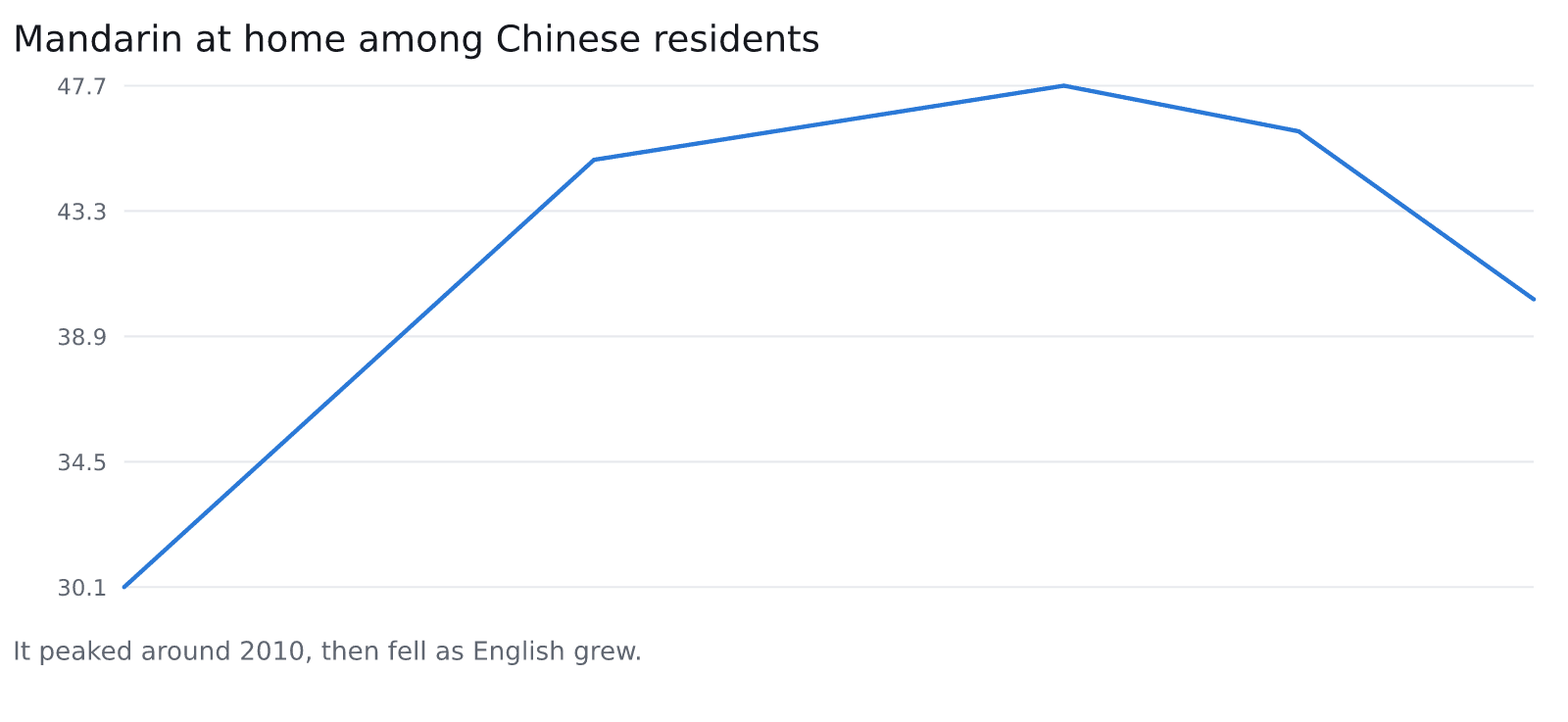
Did it work? The numbers say yes, and then they say something else. These are the shares of Chinese residents who speak Mandarin at home, from the Languages of Singapore article.
Mandarin as the home language of Chinese residents
| Census year | Share |
|---|---|
| 1990 | 30.1% |
| 2000 | 45.1% |
| 2010 | 47.7% |
| 2015 | 46.1% |
| 2020 | 40.2% |
Mandarin grew until 2010 and has fallen since, as English has grown. The campaign page puts it plainly: Mandarin’s share peaked around 2010. Expatica gives an earlier baseline from the 1980 census, when around 60% of the population spoke other Chinese varieties at home and about 10% spoke Mandarin. So within a generation, a population that spoke Hokkien, Teochew and Cantonese at home switched first to Mandarin and then, increasingly, to English.
The page also records the cost. Lee Kuan Yew called Mandarin a “stepmother tongue” for many. Some families objected to learning two foreign languages, English and Mandarin, in place of English and their own variety. Critics say younger people can’t talk with older relatives. The Malay and Indian communities argued that promoting Mandarin could weaken English as the common language.
I’m giving you the criticism because a visitor who hears “dialect” in a Singapore conversation is hearing something sensitive. It’s not an everyday word for a tourist to use. If a local brings it up, listen.
Things have since relaxed. The campaign page says dialect programmes returned to free-to-air television in 2016, and it also describes a 2026 debate over dialect films and Mandarin dubs. That debate is recent and still moving, and I’ve only read one page on it, so I won’t summarise it further.
Hokkien, Cantonese and Teochew in daily life
Where will a visitor actually hear them? The Singaporean Hokkien article says Hokkien is now mostly spoken by older generations, often at hawker centres and kopi tiams. That’s useful. The person making your coffee may well be speaking Hokkien to the person at the next stall.
The article says Hokkien was the lingua franca of the Chinese community through the 1950s and 1960s, with political speeches in it and a lively opera and storytelling scene. After 1979, the campaign, stricter censorship and mandatory Mandarin dubbing reduced its public presence, and the shift to English-medium education in the 1980s weakened it further.
You’ll also meet it without hearing it. Place names such as Ang Mo Kio, Toa Payoh and Tiong Bahru have Hokkien or Malay-Hokkien origins, the page says. And Malay words went into Hokkien the other way: sabun for soap and pasar for market. That’s the same exchange that produced Singlish, running in both directions.
The Languages of Singapore page adds a few things for the curious. It says Hokkien accounted for about half of non-Mandarin Chinese speakers as of 2022, and Cantonese for about 25%. In 2014 the information on the Pioneer Generation Package was produced in Hokkien, Cantonese, Teochew and Singlish, so older people could follow it. The 2007 film 881 revived interest in getai, the street stage shows in Hokkien and other varieties. I’d call those signs that the varieties aren’t gone, just quieter.
Singapore’s own Mandarin
If you speak Mandarin, or have been practising it for this trip, a final point. Singaporean Mandarin, per the article on it, has two forms. The standard form is used in schools and broadcasting, and is closer to Taiwan’s Guoyu than to mainland Putonghua. The colloquial form, nicknamed “Singdarin”, is informal and borrows from English, Malay, Hokkien, Cantonese and Teochew.
The article says a 1999 dictionary lists 1,560 words unique to Singapore, among them 组屋 for a public housing flat and 德士 for a taxi. So a learner may meet a Singapore word their textbook never taught. It’s another reason to expect to be misunderstood now and then and not to take it personally.
Mandarin in two minutes
If you want to try, a free online Mandarin phrasebook is the one thing I’d use.
Three Mandarin phrases and how they’re written
| English | Pinyin | Note |
|---|---|---|
| Hello | Nǐ hǎo | Two third tones in a row |
| Thank you | Xièxie | Second syllable is short |
| How much is this? | Zhège duōshǎo qián? | Use it while pointing |
Mandarin has five tones: four, plus a neutral one. The phrasebook’s example is that mǎ means horse and mā means mother, as different as “I want a cake” and “I want a coke”. So expect to be misunderstood sometimes, and don’t take it as a failure. A pointing finger and a smile do the rest.
Malay: the national language you’ll hear least
Malay is the language of the anthem, and Expatica says it was the first of the four spoken in Singapore, as the mother tongue of the ancient Melayu kingdom. It’s written in the Roman alphabet.
You’ll meet it as a visitor in food names (makan, kopi), in place names, and in the odd word Singlish borrows. Expatica says Malay has two forms in practice: the standard Singaporean Malay used by media and politicians, and bahasa pasar, “market language”, the everyday form.
It’s one of the easier languages in this list for an English speaker. Expatica says it has eight vowel sounds, all of which exist in English. It warns that spelling isn’t strictly phonetic: kamu can mean “you” or sound like “camp”, depending on the vowel.
Five Malay phrases from a phrasebook
| English | Malay | Say it like |
|---|---|---|
| Thank you | Terima kasih | TREE-muh KAH-seh |
| Good morning | Selamat pagi | SLAH-mah(t) PAH-gee |
| How much? | Berapa | buh-RAH-puh |
| Delicious | Sedaplah | suh-DAH(P)-lah |
| Excuse me | Maaf | mah’AHF |
That phrasebook is for Malay as a whole and not Singapore’s variety in particular, so a local may say things a little differently. If someone smiles and corrects you, that’s a good outcome.
Tamil, and what it means if you’re from India
This is the part no other page on Singapore’s languages writes for you. You’re probably reading this from India, so Tamil is the official language that’s closest to home.
One page I read says Tamil was chosen as an official language partly because it was spoken by the largest Indian ethnic group. Written Tamil uses the Tamil script. Expatica adds that Tamil is one of the world’s few surviving classical languages, with literature dating back to the 3rd century BCE. Tamil arrived with Indian migrants in the 19th century, when both regions were part of the British Empire.
Three things are worth knowing as a visitor.
You’ll see it. The Languages of Singapore page says a warning sign in all four official languages is found in every MRT station. The “No Alcohol” signs in Little India are in Tamil and English only. So Tamil isn’t a paper language. It’s on the wall.
It’s a minority language there. In 2010, about 36.7% of Indian Singaporeans spoke Tamil most often at home, down from 42.9% in 2000, per the Languages of Singapore page. It lists other Indian languages in Singapore as well: Malayalam, Telugu, Punjabi, Bengali, Hindi and Gujarati. It gives no home figures for them. So you may hear some Hindi, but I wouldn’t count on it, and I wouldn’t assume that a shopkeeper in Little India speaks it.
It’s not identical to the Tamil you know. Expatica says Singaporean Tamil keeps some older words that are no longer common in India, though its grammar is the same. If you speak Tamil, you’ll be understood, and you may hear a word you haven’t heard in years.
The page also lists reasons that Tamil use has declined at home. It names diverse Tamil communities, housing ethnic quotas, and a purist, textbook style of Tamil taught in schools. I’m not a linguist, so I’ll just pass that on.
Tamil in numbers, media and daily life
The Languages of Singapore page puts the Indian share of the population at 9.2% in 2010, and says Tamil’s share of the whole population at home has stayed just above 4% across the censuses it covers. That’s different from the 2.5% in the 2020 table above, and I can’t reconcile the two from here. The likeliest reason is the different years and definitions, but I can’t prove it, so I’d read both as “a small, steady minority”. The travel guide says Indians are about 9% of residents, with Tamils the largest subgroup, followed by Malayalees, Punjabis and Sindhis.
The page on Singaporean Tamil calls it the most spoken Indian language in Singapore, and the only Indian language among the four official ones. It also lists the media. There’s a Tamil daily, Tamil Murasu. There’s a state-subsidised free-to-air Tamil channel, Vasantham. And there’s a Tamil radio station, Oli 96.8FM. The page adds that Tamil is used in temples, mosques and churches, and that some businesses in Little India use it every day.
A visitor from India might find the next detail oddly familiar. The main article says that in 2013 a group of Tamil speakers asked the Civil Aviation Authority to put Tamil on signs at Changi Airport in place of Japanese, and noted that about 5% of the population speaks Tamil. I don’t know how that petition ended, and the page I read doesn’t say, so I’m only telling you that the question was raised. It shows how much people care about where Tamil appears.
The same page says Vasantham gives specific time slots to other Indian languages, and some local cinemas show films in those languages. So a Hindi, Telugu or Malayalam speaker has something, just not much.
Other Indian languages at school
If you’re wondering about Hindi, the school system gives a clue. The Languages of Singapore page says Indian students can take Tamil as their Mother Tongue, or, for non-Dravidian languages, Hindi, Bengali, Punjabi, Gujarati or Urdu. Where a school doesn’t have enough students for a language, it’s offered at designated language centres.
So Hindi is taught, but in a corner of the system. That’s consistent with what I said earlier: you may hear it, and you can’t count on it.
Tamil during the festivals
If you’re visiting around a festival, you’ll hear Tamil a lot more. The travel guide says Deepavali, around October or November, brings bright decorations to Little India. Thaipusam, in January or February, brings processions from the Sri Srinivasa Perumal Temple in Little India to the Sri Thandayuthapani Temple on Tank Road. And Thimithi, a fire-walking festival, takes place about a week before Deepavali at the Sri Mariamman Temple in Chinatown.
I can’t tell you what the crowds will be like on a given date, and the dates move each year, so check them against the year you’re going. What I can say is that the language will be on the street, on the temple loudspeakers and in the shops.
Five Tamil phrases from a phrasebook
| English | Tamil | Say it like |
|---|---|---|
| Hello | Vanakkam | vuh-nnuhk-kuhm |
| Thank you | Nandri | nuhn-drih |
| Yes | Aamaam | ah-mahm |
| No | Illai | ihl-ligh |
| Excuse me | Mannikkavum | muhn-nihk-kuh-vum |
If you do speak Tamil, a “vanakkam” in Little India will land warmly. I can’t promise the person answering will reply in Tamil. They may well reply in English, and that’s fine too.
How the school system made this
Why does a small country have this arrangement? The answer is a school rule.
The language education page says Singapore uses an English-based bilingual system. English is the medium of instruction, and each student’s mother tongue is taught as a second language. The policy was officially introduced in 1966. The mother tongues are Mandarin for Chinese pupils, Malay for Malay pupils and Tamil for most Indian pupils.
Since 1 January 2011, the main article says, a student’s Mother Tongue is defined solely by their official registered race. And a second language has been compulsory in primary schools since 1960 and in secondary schools since 1966.
The result is a country where nearly everyone learns English at school and a second language beside it. That’s why a taxi driver, a student and a hotel receptionist can often move between English and another language in one afternoon. It’s also why so many people end up with a mix of both in a single sentence.
There’s a catch that the government has admitted. One page I read says that in 2004 the government acknowledged English had become dominant in most homes, and that its original goal of equal proficiency in English and the mother tongue hadn’t been achieved. Concerns persist about falling Mother Tongue skills, especially Mandarin. For a visitor it means the English is strong, and the other three vary.
How the school rules changed over time
The language education page tells a longer story than the headline. After the Second World War, it says, the government brought schools under state control and chose English as the common language, though Malay was briefly considered. When the bilingual policy was introduced in 1966, English could at first be taught as either a first or a second language. Schools that taught it as a second language saw enrolment fall, and many closed or switched.
High dropout rates led to a streaming system in 1979. In 1992 it was reshaped into EM1, EM2 and EM3 at primary level, with the only difference between EM1 and EM2 being that EM1 offered Higher Mother Tongue. From 2004, the Ministry began replacing streaming with subject-based ability banding.
Milestones in school language policy
| Year | What changed |
|---|---|
| 1960 | Second language compulsory in primary schools |
| 1966 | Bilingual policy officially introduced; second language compulsory in secondary schools |
| 1979 | Streaming introduced after high dropout rates |
| 1992 | Streaming reshaped into EM1, EM2 and EM3 |
| 2004 | Subject-based ability banding begins to replace streaming |
Mother Tongue is compulsory at PSLE, O Level and A Level, even though English is the medium of instruction. The page says both languages got double weighting in 1972, and since 1980 each has had the same weighting as mathematics and science. Exemptions, or a simpler Mother Tongue “B” syllabus, can be granted case by case, for example for dyslexia or long periods abroad.
Why does that matter for a visitor? Because it’s the reason almost everyone you meet has a second language at school-level and a first one that is English. It’s also why the Mother Tongue is such a charged subject. The page reports parents complaining that weak Mother Tongue results can block progression even when other results are good, and a petition supporting reduced weighting. It says that in 2010 the Prime Minister, Lee Hsien Loong, said the weighting would not be reduced, and that teaching and exam formats would be improved instead.
What the home-language numbers say about the policy
The page gives 2010 home-language figures for each group. Mandarin was the home language of 47.7% of Chinese Singaporeans. Malay was the home language of 82.7% of Malay Singaporeans. Tamil was the home language of 36.7% of Indian Singaporeans.
Home language by community, 2010 census
| Community | Official mother tongue | Spoke it most at home |
|---|---|---|
| Chinese Singaporeans | Mandarin | 47.7% |
| Malay Singaporeans | Malay | 82.7% |
| Indian Singaporeans | Tamil | 36.7% |
The gap between the three is the real story. Malay holds its ground at home far better than Tamil or Mandarin. The Languages of Singapore page says Malay faces competition from English as well, though it remains important in madrasahs and religious classes. For a visitor, it means the Malay-speaking community is the one where the mother tongue is most alive in daily conversation, even though the language is quietest in the shopping malls.
The Chinese figure comes with a note. The page says the Mother Tongue “B” syllabus and the EM3 stream were brought in for students who struggled with two languages, and that the EM3 stream has since been discontinued. It also says that, since 1 January 2011, Mother Tongue is decided by a student’s registered race, where earlier it followed the father’s ethnicity.
Malay at home and on paper
Two more facts from the Malay section, because they’re the sort of thing that surprises people. The first is the script. The page says Rumi, the Roman alphabet, replaced Jawi as the main script. That’s why you can read Malay words on a Singapore sign without learning a new alphabet.
The second is pronunciation. Singapore adopted the sebutan baku standard in primary schools in 1993, and the page says Malaysia dropped it in 2000. So Singapore and Malaysia now differ a little in how some words are said at school. A visitor will never notice that, and I mention it only because it shows that even a small language has its own politics.
Expatica adds that Malay has “bahasa pasar”, market language, as the common tongue for most Malay speakers in Singapore, with standard Malay used on radio, television and in newspapers. It also gives two words for “you”: awak for informal use and anda for formal. If you’re only passing through, use neither. Say “terima kasih” and smile.
Languages most visitors never meet
Three more are worth a line, mostly because they’re why a page like this can’t stop at four.
Kristang. The Languages of Singapore page says it’s a creole spoken by Portuguese Eurasians in Singapore and Malaysia, developed from Portuguese mixed with Malay, Chinese, Indian and Arab borrowings. As of 2006, the page says, it was largely spoken by the elderly. You’re unlikely to hear it by chance.
Singapore Sign Language. The Singapore Sign Language article says it hasn’t been recognised as a national sign language, but the deaf community treats it as Singapore’s native sign language. It has been developing since the first school for the deaf opened in 1954. Expatica says it blends American Sign Language, Shanghainese Sign Language and Signing Exact English. I left out the headcount of deaf people that Expatica gives, because I couldn’t confirm it anywhere else.
More on sign language, since the question comes up. The Singapore Sign Language article says the first deaf school opened in 1954 and taught in Shanghainese Sign Language. American Sign Language was introduced in 1974, and Signing Exact English was brought back in 1976. The Singapore School for the Deaf closed in September 2017.
The article estimates about 6,000 signers, as of 2021, a count that includes pidgin signed English. It also says that no formal linguistic study has been done, largely because funding is limited. For a visitor, the practical point is small: a deaf person you meet may sign in a mix of these. Writing a message on your phone works in English.
Other Indian languages. Covered above. If you speak Malayalam, Telugu, Punjabi, Bengali or Gujarati, you share a language with parts of the community, but you can’t expect it in a shop.
Where each language turns up on a trip
A table of languages is tidy. A day isn’t. Here is where I’d expect each language on a normal visit, using what the sources say and flagging what’s my own guess.
Where a visitor is likely to meet each language
| Place | Likely language | Basis |
|---|---|---|
| Hotel desk, airline, large shops | English | Travel guide: English is the most common language |
| Government counters | All four available | Travel guide: offices must serve in all four |
| MRT station | A warning sign in all four | Languages of Singapore page |
| Hawker centre or kopi tiam | English, with Hokkien among older speakers | Languages of Singapore page, my own listening |
| Little India | Tamil and English, with Tamil signs | Languages of Singapore page |
| Parade or national event | Malay | Languages of Singapore page: anthem and drill commands |
The hawker row mixes a source and a guess, and I’ve marked it so. The source says Hokkien is mostly spoken by older generations at hawker centres and kopi tiams. That the staff will also answer you in English is my own expectation, which I couldn’t check.
Arriving at the airport
The travel guide says to complete the SG Arrival Card online, no earlier than three days before you arrive, and that Singapore no longer stamps passports, so the terms of your entry are emailed to you. That’s about paperwork, not language. But it’s the first thing that will be in front of you, and it’s in English. So is almost everything else you’ll read in the arrival hall.
Taxis and ride-hailing from Changi, the same page says, cost about $20 to $30 to the city. If you’re sharing the ride with a driver who speaks quickly, show the hotel address on your phone. I’d do that even when the driver speaks perfect English, because the screen settles any doubt about spelling.
On the MRT
The Languages of Singapore page says every MRT station has a warning sign in all four official languages. Announcements are another matter. I looked and couldn’t find a source for which languages the trains announce in, so I’ll only say what I know: the signs are readable and the map is in English.
At a hawker centre
You’ll hear “makan” and “tapao” and “chope”. “Tapao” means takeaway, for cooked food. “Chope” means reserve a seat, and in practice it’s done by leaving a small object on a table. The vocabulary page defines the word but not the habit, and I only know the habit from reading and from friends, so take it as hearsay and watch what other people do.
For ordering, use the simplest English you can, and point. Say what you want, not the long version of how you want it. Most stalls are quick, and a short order is a kindness to the queue behind you.
In a taxi, a shop or a hotel
English, mainly. I’d keep sentences short and avoid idioms from home. “Can you do the needful?” will confuse someone who has never read an Indian office email. Say what you want: “Please take me to this hotel.”
In Little India
This is where your own languages count for more. Tamil signs are there, and Tamil speakers, and a good number of South Asian shops and restaurants. The travel guide says Little India is the main district for the Indian community. I’d still start in English, as I said before, and let the person choose the language. If they switch to Tamil, answer in Tamil. If they switch to Hindi, you’ve learned something about them.
How to prepare in a week
You don’t need a course. Here’s the plan I’d give a cousin who flies in a week.
- First day. Learn “thank you” in the languages you’re most likely to use: terima kasih, xièxie, nandri. Practise with a phrasebook. Online phrasebooks give the pronunciations.
- Second day. Read the Singlish tables on this page again. The point isn’t to speak it. The point is to recognise “lah” when you hear it, so it doesn’t throw you.
- Third day. Write your hotel name and address on your phone, and screenshot the booking, so you can show it without signal.
- Fourth day. If you speak Tamil, refresh a few phrases. Don’t expect a conversation in it. Expect a smile.
- Fifth day. Listen to a little Singapore English online, an interview or a news clip, to tune your ear to the rhythm. It’s my own tip, not a sourced one, and it works because the sound is the hard part, not the words.
- Sixth day. Check your entry rules for your dates on the official site, because rules change. I can’t tell you what they are today.
- Seventh day. Pack. Language is not the thing that will go wrong.
The week in short
| Day | Do this |
|---|---|
| First | Learn thank you in three languages |
| Second | Read the Singlish tables again |
| Third | Save the hotel address on your phone |
| Fourth | Refresh a few Tamil phrases, if you speak it |
| Fifth | Listen to Singapore English |
| Sixth | Check entry rules for your dates |
| Seventh | Pack |
I’ve kept this short deliberately. A longer plan would be me pretending a four-day holiday needs a language curriculum.
What not to worry about
A few worries I hear, and my honest answers.
“I don’t speak Mandarin.” You don’t need to. Most of what you’ll do, you’ll do in English.
“My accent is Indian.” Singapore has an Indian community of its own, and the travel guide says Indians are about 9% of residents. I can’t promise how any one person will hear your accent. Speak plainly and slowly, and you’ll be understood as well as anyone is.
“I’ll offend someone with the wrong word.” It’s unlikely if you stay with standard English. The one word I flagged was “ang moh”, which the Singlish vocabulary page says some find mildly derogatory. Don’t use it, and you’re fine.
“I can’t read the signs.” Most signs you need are in English. Tamil signs are in Tamil and English together. Your phone’s camera translation, if you use one, is a fallback, and I haven’t tested how well it does with Singapore’s mixed signs, so I won’t promise it.
What to do on arrival
A few habits, all mine, none of them sourced facts. Take them as the checklist I’d give a cousin.
Start in standard English, at an ordinary pace. The travel guide’s advice is right. If the person doesn’t follow, simplify, don’t speed up or shout.
Keep your hotel name and address written down. Show the screen if a spoken address doesn’t land.
Use “can?” if you hear it. It means what it sounds like.
Say thank you in a local language if you can. “Terima kasih” or “xièxie” is a courtesy, and nobody expects more.
If you speak Tamil, use it in Little India with a smile, and be ready for English back.
Don’t copy Singlish. Enjoy it.
The honest gaps
Here’s what I couldn’t find.
I couldn’t open Singapore’s own statistics pages, so the census figures come from a reproduction of them. I couldn’t confirm which languages the MRT announces in, so I haven’t said. I couldn’t settle whether street signs use simplified or traditional Chinese, because two pages disagreed. And I read only the first part of the long Languages of Singapore article.
None of that changes the practical answer. For a visitor, English works, and the rest is a bonus.
If you’re still choosing dates, our best time to visit Singapore guide covers the months, and the December weather post shows how afternoon rain shapes a day. If you’re thinking of a ship, the cruise guide lists the lines to ask about. Entry rules change, so check them for your dates, and ask us about visa assistance if you’d like a hand with the forms.
Frequently asked questions
What language do they speak in Singapore?
Four official languages: English, Mandarin, Malay and Tamil. English is the main one in daily life, government and business. In the 2020 census, 48.3% of residents spoke English most often at home, and 29.9% spoke Mandarin.
Is English enough to travel in Singapore?
Usually, yes. One travel guide says almost every non-elderly Singaporean speaks English with varying fluency. Speak standard English at a normal pace, and simplify if someone doesn’t follow.
What is Singlish?
An English-based contact language from Singapore, with Malay, Hokkien, Cantonese, Teochew and some Tamil mixed in, per the Singlish article. It uses sentence-end words like lah, lor and leh. A 2018 study found 8% of Singaporeans call it their primary language.
Is Tamil spoken in Singapore?
Yes. Tamil is an official language and it appears on signs, including a warning sign in all four official languages in every MRT station. It was the home language of about 36.7% of Indian Singaporeans in 2010, and 2.5% of all residents at home in 2020.
What is the national language of Singapore?
Malay. The Languages of Singapore page says it’s the national language in the constitution and is used in the anthem, in orders and decorations, and in military foot-drill commands. Expatica calls its role mainly ceremonial.
Do I need to learn Mandarin before I go?
No. Mandarin is widely spoken at home, but a visitor can manage in English. If you want to try, learn “xièxie” and “duōshǎo qián”. Mandarin has five tones, so expect to be misunderstood now and then.
Will Hindi work in Singapore?
I wouldn’t count on it. The Languages of Singapore page lists Hindi among the minority Indian languages, but it gives no figures. Use English, and Tamil if you have it, in Little India.
Why do Singaporeans speak Singlish?
It grew from contact between English and the languages at home, per the Singlish article: Malay, Hokkien, Cantonese, Teochew and some Tamil. English-medium schooling took hold from the 1830s, and by 1984 all schooling was in English. A 2024 survey figure on the same page says 71.1% found it appropriate with friends.
Is Singlish rude or hard for a tourist?
Neither, usually. One travel guide says Singlish can be hard to follow and advises avoiding it unless you use it correctly. The particles like “lah” and “meh” carry mood, not rudeness. Listen first, speak standard English.
Why did Singapore choose Mandarin over Hokkien or Cantonese?
The Speak Mandarin Campaign page says Lee Kuan Yew chose it to unify the Chinese community under a single language, and the Speak Mandarin Campaign began on 7 September 1979. Critics say it left younger people unable to talk with older relatives.
Which language does a Tamil speaker from India need in Little India?
Tamil is used on signs and in shops there, per one travel guide, but start in English and let the other person choose. If they switch to Tamil, you can too.